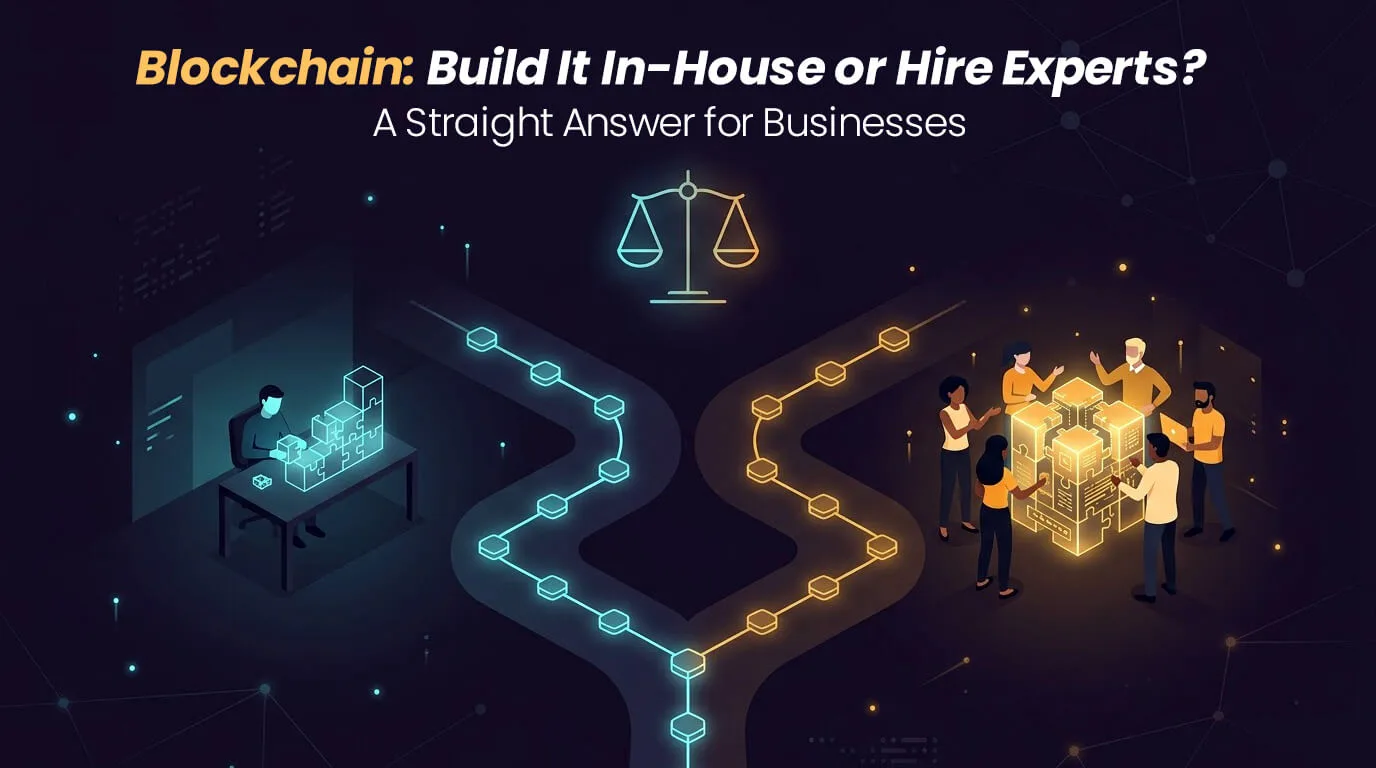
"Let's just hire a blockchain developer."
Someone always says this in the leadership meeting, like it's a normal sentence. Like blockchain developers grow on the same tree as React developers, sitting around on LinkedIn waiting for a job posting to land in their inbox.
They don't. And that's really where this whole decision starts. Not with strategy. Not with architecture diagrams and consensus mechanisms. With a duller question nobody wants to ask out loud first: can we actually find, hire, and keep the people this requires?
Most companies can't. Not easily. Not without paying a premium that quietly kills the "cheaper in-house" argument before anyone's even finished making it.
Blockchain isn't like bolting a new module onto an app you already have. It's a different trust model. A different failure mode. And — this is the part everyone skips past — a genuinely different kind of mistake. A bug in a normal feature gets a hotfix, a deploy, an apology in the changelog. A bug in a smart contract that's already live on a ledger can mean funds are gone. Not delayed. Gone. No undo button. No support ticket that fixes it. No rolling back to yesterday's backup, because yesterday's backup isn't how this works.
That one fact changes the whole calculus. This isn't a "let the junior dev figure it out" kind of project, and pretending otherwise is how companies end up in the case studies nobody wants to be featured in.
Fifteen minutes of honest thinking before anyone starts interviewing. That's really all this section is asking for.
Here's what the spreadsheet always misses. A blockchain architect who genuinely knows what they're doing — consensus mechanisms, smart contract security, key management, all of it — is rare enough that hiring one takes months. Not weeks. I watched a company spend five months trying to fill a single role. Meanwhile paying two mid-level developers to "learn on the job," with production data sitting one bad commit away from disaster.
That's not a hypothetical. That's Tuesday, for a lot of companies that went this route and didn't tell anyone how it actually went.
Add it up honestly. Recruiter fees, or months of your own team's time screening candidates who oversell their résumé. Onboarding time — even a strong hire needs weeks to actually understand your business logic, not just blockchain theory. Ongoing security auditing, because smart contracts genuinely need external audits before going live, and that's not a skill you build in-house cheaply. Or quickly. Or, frankly, at all, in most cases. And the opportunity cost of a slower launch, while whoever partnered with an established blockchain development company is already live and taking the market you were still interviewing for. None of this shows up in a clean "in-house salary versus agency invoice" comparison. It's real money. It just hides in the delay column, where nobody's looking.
Not because in-house teams are incapable. Good engineers are good engineers, wherever they happen to sit. It's that an established partner already made the expensive mistakes — on somebody else's project, years ago — and built the process around never repeating them.
They've deployed permissioned ledgers before. So they know which consensus mechanism actually fits your use case, instead of picking whichever one had the flashiest conference talk that year. They've had smart contracts audited — repeatedly, by multiple firms, across multiple projects — so they know what a real audit looks like, not a checkbox exercise dressed up as one. They've handled key management incidents at other clients, meaning they've already built the recovery protocols you'd otherwise be inventing from scratch. Under pressure. The first time something breaks. Which is exactly the worst possible moment to be inventing anything. That last part matters more than people expect going in. A team's first blockchain security incident is a brutal teacher. A specialist partner has usually already sat through that class, on somebody else's dime.

Illustrative typical timelines based on enterprise blockchain engagement patterns — not a specific client dataset.
I'm not going to pretend outsourcing is always the answer. That would be exactly the one-size-fits-all pitch I warned you to be suspicious of a few paragraphs back — and I'd deserve the skepticism right back.
In-house makes real sense when blockchain isn't a project. It's the product. If your entire business model is a blockchain platform — not a feature bolted onto something else — you'll need deep in-house expertise eventually, regardless of who builds version one. A fintech building a settlement layer as its core offering can't outsource that capability forever. It's too central to what the company actually is.
It also makes sense at real scale. When you're running enough parallel blockchain initiatives that a dedicated team pays for itself across several projects, not just the one. And it makes sense when the IP itself is the moat — if your edge is a proprietary consensus mechanism or a genuinely novel smart contract design, you probably don't want that logic living primarily inside an external vendor's head, however good they are.
For everything short of that — a single use case, a defined scope, a business that needs blockchain to solve one specific trust problem rather than become the whole business — in-house is usually just the expensive way to learn lessons someone else already knows cold.
Here's the bit vendors don't love mentioning, because it's less lucrative than selling a full build: plenty of companies land somewhere in the middle. And it works. Fine, even.
Bring in a blockchain development company for the first deployment — architecture, audited smart contracts, the production pilot. Keep your own team embedded alongside them the whole way through, not just receiving a handoff document at the end like a consolation prize. Then, once the system's live and stable, gradually bring maintenance and iteration in-house, with the specialist partner staying on for security audits and the bigger upgrades.
That gets you a production-grade first deployment without betting the company on a hiring process that might eat half a year. And it builds real internal capability over time — instead of either permanent dependency, or a rushed in-house build that skips every expensive lesson on the way to a launch date nobody was ready for.
| Aspect | In-House Build | Specialist Partner |
|---|---|---|
| Time to first hire | 3–6 months for the right architect | Immediate — team already assembled |
| Smart contract audit capability | Usually needs an external firm anyway | Built into the engagement |
| Cost profile | High upfront, ongoing salaries after | Project-based, front-loaded |
| Best fit | Blockchain is the core product | Blockchain solves one business problem |
| Risk of early mistakes | High — learning happens on your ledger | Lower — mistakes already made elsewhere |
| Long-term ownership | Full control, slower start | Faster start, phased handover possible |
Illustrative comparison based on typical enterprise blockchain engagement patterns — not a single client dataset.
A few honest questions worth sitting with. Before anyone posts a job listing, or signs a vendor contract.
If the honest answer is "we need this solved well, reasonably fast, without betting the company on a hiring cycle" — that's exactly the case a blockchain development company exists for. Swaran Soft's blockchain and distributed ledger work is built around that production-first approach: architecture, audited smart contracts, integration with your existing systems. Not a proof-of-concept that quietly dies the week after the demo. And for companies weighing the hybrid path specifically — bringing in expertise now while building internal capability over time — the same build-operate-transfer thinking behind Swaran Soft's AI strategy and consulting work applies here too, almost without modification.
Worth a look at Swaran Soft's case studies if you want to see what that discipline actually looks like — production systems still running, not pilots that got quietly shelved six months in.
There's no universally right answer between building in-house and hiring experts. But there's absolutely a wrong way to make the decision — guessing, based on whatever looks cheaper on a spreadsheet, without ever pricing in the eighteen months of learning curve nobody put a number on.
We map your blockchain use case against both paths and recommend a scoped first deployment — at no cost.
Find out whether to build in-house, hire a partner, or do both in sequence.

AI Architect and Entrepreneur building India's Edge AI ecosystem. 25+ years in enterprise technology. Founder of Swaran Soft, Gignaati, and Copilots.in.