Hire the wrong app developer and it'll cost you. Months, budget, sometimes control of your own product. But here's the thing most people miss: the warning signs show up early, right in those first few conversations, if you know what you're looking at. So before you sign anything, run through this. I've also flagged the stuff that should make you walk.
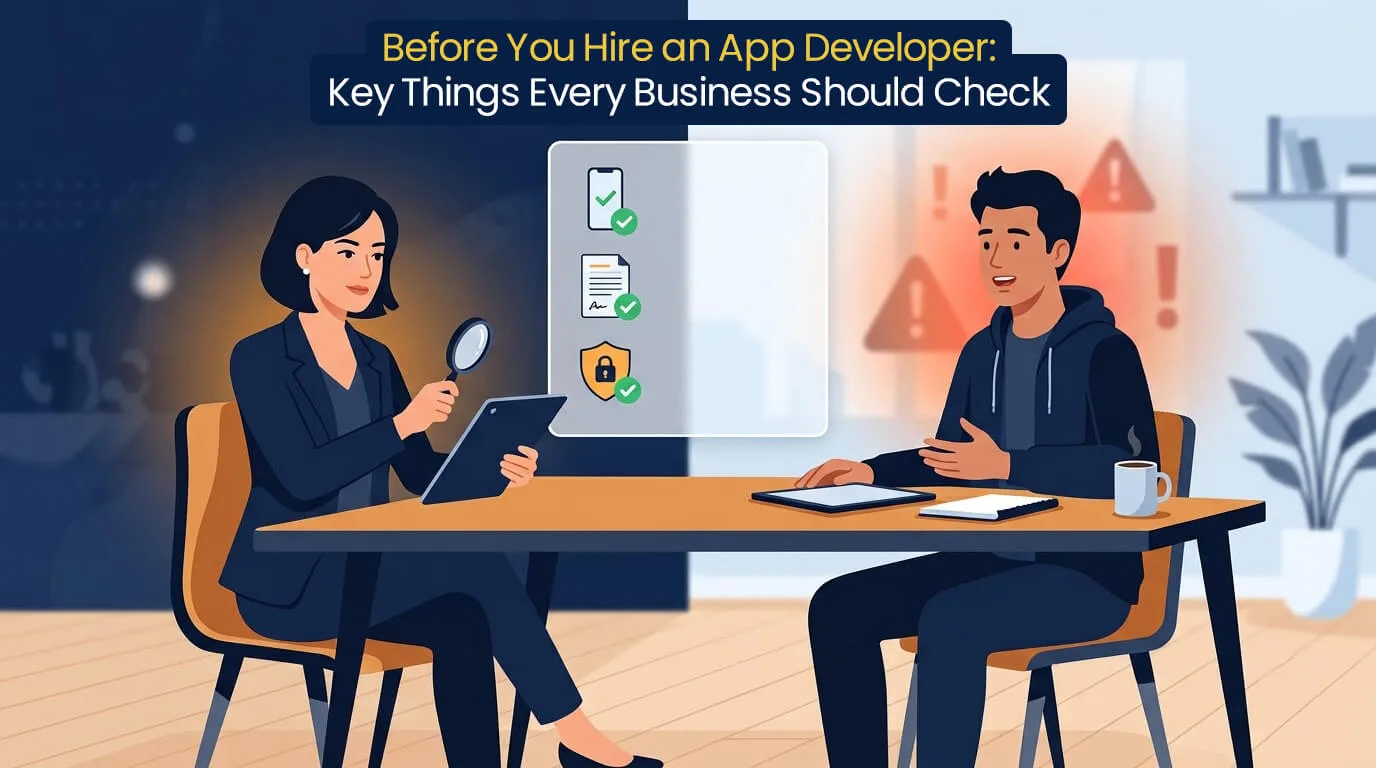
On paper, picking an app developer looks like a simple purchase. It isn't. Get it wrong and you lose a lot more than money.
You lose months rebuilding something that should've worked the first time. You can lose control of your own product, because someone else quietly registered it under their account. And you can end up with an app that runs fine today but nobody can maintain tomorrow.
What gets me is how avoidable most of it is. The developers who cause these messes tend to show their hand early, while you're still deciding. A fuzzy answer about ownership. A portfolio that's all designs and no live apps. A quote that lands at half of everyone else's. None of that is subtle. It's just easy to miss when you're keen to get going.
So slow down for one meeting. The checklist below takes an afternoon, and it'll tell you more than any brochure. Work through it before you sign. Your odds go up a lot.
Run every candidate through these. A strong one clears all six without a fuss.
Anyone can show you gorgeous screens. Fewer can point to apps in the store that real people open every day. Ask for live apps at roughly your complexity. Then download them and use them yourself. How an app feels in your hand tells you more than any slide will. And a developer with nothing shipped? They're practising on your project.
Get this into the contract before anyone writes a line: the code, the IP, and the app-store accounts are yours. This is the single most common trap businesses walk into. They find out after launch that they can't move, because the developer holds all the keys. A good partner writes your ownership in without being asked twice.
Good developers don't open with code. They open by understanding the problem, the users, the goal. Then they scope it. Hand you a price and a timeline before they know what you're building? Careful. Discovery is where the expensive mistakes get caught, long before anyone builds them.
The build is the short part. Living with the app is the long part. So ask what actually happens once it's live. How do bugs get handled? How do updates work when the OS changes? What does it all cost? A developer with no answer, or one who treats launch as the finish line, leaves you stranded with something you can't maintain.
Here's a rule worth keeping: however responsive they are while chasing your business is about as good as it gets. If replies are slow and answers are vague now, it only gets worse once you've paid. You want a named contact, regular updates, and a way to see the work take shape. You should never be left wondering what's happening to your money.
If your app touches customer data, the developer should raise security and privacy before you do. Ask how they handle data protection and the DPDP Act. A team that brings this up unprompted has usually shipped real products for real businesses. Silence on security usually means they haven't, or they don't much care.
The left column should make you pause. The right is what a developer worth hiring actually looks like.
| Red Flag | Green Flag |
|---|---|
| Only mockups and designs, nothing live | A portfolio of apps you can download and use right now |
| Vague or cagey about who owns the code | Clear and in writing: you own the code, IP, and store accounts |
| A quote far cheaper than everyone else | Fair pricing tied to a clear scope. Suspiciously cheap gets rebuilt |
| Jumps straight to coding your idea | Starts with discovery, understanding the problem first |
| Support ends the day you launch | A defined maintenance and update plan for after go-live |
| Slow to reply, hard to pin down | A named contact, regular updates, visible progress |
| Won't connect you with past clients | Happy to share references you can actually call |
| Never once mentions data security | Raises data protection and DPDP without being asked |
If you take one thing from this, take this. Settle ownership before a single line of code gets written. The businesses that get burned are almost always the ones who left it vague.
The source code is your asset. It should be handed over and stored somewhere you control. Not sitting on the developer's laptop.
Your Apple and Google Play accounts belong in your name. If the developer owns them, they own your spot in the store.
The intellectual property is yours, in writing. No ambiguity, no shared claims, no nasty surprise if you ever part ways.
At Swaran Soft, ownership isn't a negotiation. Your code, your IP, your app-store accounts are yours from day one, in writing, with a proper handover and documentation to match. We'd rather earn your next project than hold your last one hostage. And honestly? If a developer digs in on this one point, that resistance is the most useful thing they'll ever tell you.
No universal winner here. Just the right fit for your budget, your timeline, and how long you'll actually need them.
| Factor | Freelancer | Boutique Agency | Large Agency | In-House Team |
|---|---|---|---|---|
| Cost | Lowest | Moderate | Highest | High, ongoing |
| Range of skills (design, dev, QA) | Narrow, one person | Full team | Full team, specialised | Depends who you hire |
| Continuity if someone leaves | High risk, single point | Covered by the team | Well covered | Your risk to manage |
| Post-launch support | Often none | Usually included | Formal, SLA-backed | You own it |
| Speed to start | Fast | Fast | Slower onboarding | Months to hire |
| Ownership clarity | Varies, check it | Usually clear | Clear, contractual | Yours by default |
| Best suited for | Small, simple apps | Most business apps | Large, complex programmes | App-first companies |
Score each developer against these. The more they clear, the safer the hire.
Real apps in the store, at roughly your complexity, that you can download and use.
Code, IP, and store accounts in your name from day one, in the contract.
A process that understands the problem first, not one that quotes on a hunch.
Clear terms for bugs, updates, and OS changes after go-live, with costs attached.
Past clients you can call, offered without hesitation or excuses.
Pricing tied to a defined scope, not a suspiciously low headline number.
Pain: Fear of overpaying, being oversold features, or getting locked in with no ownership of the finished app.
Outcome: A clear checklist to vet developers, ownership secured in writing, and a partner who sticks around after launch.
Pain: Cheap freelancers who vanish, or agencies that overbuild and overcharge. Hard to judge who'll actually deliver.
Outcome: A partner with live apps and real references, a right-sized scope, and code and IP owned by the startup.
Pain: Needs proof of delivery, security maturity, and SLA-backed support. Not promises in a pitch deck.
Outcome: A vetted vendor with a track record, solid security and DPDP practices, and contractual support and ownership terms.
"Watch how a developer answers 'who owns the code?' The good ones say 'you do' before you've even finished the question. The rest start explaining. That one moment tells you most of what you need to know."
A printable checklist to score any app developer against these six things, plus a free 20-minute review of your shortlist.
Get the printable checklist and a free review of your shortlist.

AI Architect and Entrepreneur building India's Edge AI ecosystem. 25+ years in enterprise technology. Founder of Swaran Soft, Gignaati, and Copilots.in.