It's the first real fork in any enterprise AI plan, and the wrong turn gets expensive. Hire a team and you wait a year before shipping anything; partner blindly and you'll get stuck. Here's a closer look at the real costs of each approach, and why the best answer is often neither one on its own.
"Should we build our own AI, or do we bring in an outside firm?" is not the right question. It sounds like a clean choice between two doors. It isn't. Framed that way, it nudges you toward a permanent decision when what you actually face is a sequence.
Here's what usually happens when a company commits to building first. HR spends four to six months finding a lead who can actually do the work, because good AI engineers in India are in short supply and not cheap. That lead then needs a small team, which takes a few more months. By the time everyone's in place, the better part of a year has gone, and the first project they ship is, honestly, their practice run.
Now here's what usually happens when a company hands the whole thing to an outside firm and walks away. The system ships. It works. And a year later the company realises it can't change a line of it without calling the vendor, because the vendor built on something proprietary that no one internal understands. That's the other failure mode, and it's just as expensive.
Partner-first ships a pilot in weeks and lets you build the in-house team in parallel, against a working blueprint.
The key question is smaller, but it matters more: how can we make a system that works fast, without giving up control? If we can answer that, the argument about building versus partnering fades a lot.
The salary line is the part everyone sees. It's rarely the part that hurts. Below is where the money and time actually go when you build from zero.
| Cost You See | Cost You Feel Later |
|---|---|
| Salaries for an AI lead and a small team | Four to six months of recruiting before anyone starts, then retaining them once trained |
| Cloud or hardware for training and inference | Choosing the wrong setup early because no one has done it before, then paying to redo it |
| The first project's headline budget | The overrun, because a team's first AI build is where they learn what they didn't know |
| Time booked on the roadmap | The quarters the project idles while the team is still being assembled |
None of this is an argument against ever building a team. It's an argument against building one before you've shipped anything. Prove the value first. Then hire, knowing exactly what you're hiring for.
Not a licence. Not a slide deck. The right enterprise AI company brings six things you'd otherwise have to build the hard way.
Your first AI project is someone's tenth. The dead ends, the model choices that looked good and weren't, the integration snags that only show up in production — a partner has hit all of them before, on someone else's clock. You inherit the shortcuts, not the scar tissue.
Plenty of teams can produce a demo. Far fewer can turn that demo into something that runs on live data every day, survives a security review, and holds up when volume triples. An enterprise partner is measured on the second thing.
Build the first use case cheaply and you often pay for it twice, because the second one starts from nothing. A partner who's done this before lays a modular foundation — shared data pipelines, security, monitoring — so use case number two plugs in instead of starting over.
Privacy and audit requirements are cheap to design in and expensive to bolt on. A team that works with Indian enterprises builds for the DPDP Act and sector rules as a matter of habit.
The best outcome isn't a system you depend on the partner to run. It's a system your own engineers understand, because they helped build it. Documentation, runbooks, and side-by-side working mean the knowledge stays after the partner leaves.
In-house AI budgets have a way of drifting, because so much of the work is discovery. A fixed-scope pilot with a costed roadmap turns that fog into a number you can take to finance.
Every item on the left is a real thing that slows down an in-house build. The right column is what a partner does about it.
| The In-House Trap | How a Partner Handles It |
|---|---|
| Hiring a capable AI team takes 9 to 12 months | A partner is productive in week one; you build the team in parallel while the project moves |
| Senior ML engineers are scarce and hard to retain | You rent senior expertise for the pilot, then hire against a proven, working blueprint |
| Your first in-house project is really an experiment | The partner's first project for you is their tenth equivalent; the mistakes are already paid for |
| Infra and tooling choices get made blind | A reference architecture chosen from experience instead of trial, error, and rework |
| Compliance surfaces at the finish line | DPDP and sector rules designed in and reviewed before anything goes live |
| No one to call when it breaks after hours | SLA-backed monitoring and support from a team that has run systems like this before |
| Critical knowledge lives in one person's head | Runbooks and documentation make the capability institutional, not dependent on one hire |
| The budget quietly balloons with rework | A fixed-scope pilot and a costed roadmap keep surprises the exception, not the rule |
Whether you build or partner with an enterprise AI company, two choices decide whether you stay in control: keep your data in India, and keep your architecture open.
On-premise and India-hosted deployment keeps customer, employee, and financial data inside your walls. The clean path to DPDP Act compliance.
A model-agnostic, open-source-friendly stack means no single vendor owns your roadmap. You can swap components without a rebuild.
Documentation and training make the system your team's to run. That's what turns a partner from a dependency into a head start.
Swaran Soft builds on an open stack and can deploy on-premise through Copilots.in, our group company running NVIDIA-powered AI infrastructure for Indian enterprises. Partner with us for the first wave through our AI strategy and consulting and Agentic AI development practices, and the system that ships is one your own engineers are trained to operate.
Freelancers and big consultancies are on the list because enterprises genuinely weigh them against an enterprise AI company.
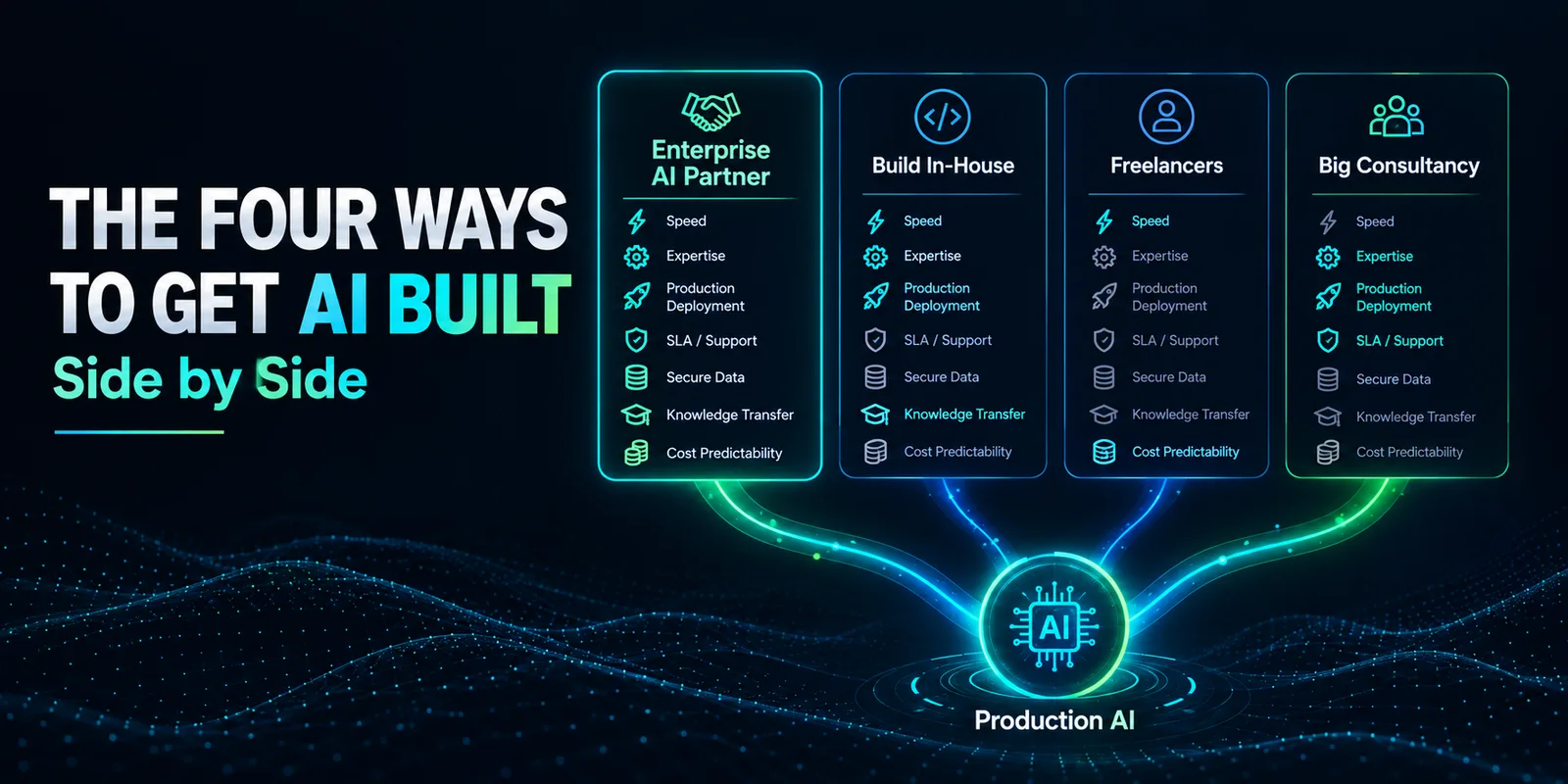
| Factor | Enterprise AI Partner | Build In-House | Freelancers | Big Consultancy |
|---|---|---|---|---|
| Time to first working result | Weeks, pilot starts immediately | 9–12 months to even staff up | Fast start, uneven finish | Months of discovery first |
| Senior AI expertise on hand | Yes, from day one | Only after you hire and retain it | Varies wildly by individual | Yes, but advisory-focused |
| Delivers a production system | Yes, strategy to go-live | Eventually, once the team matures | Often stops at a build | Usually a plan, not a system |
| Ongoing support and SLA | Included, SLA-backed | You staff and own it | Rarely | Separate engagement |
| Data stays in India / on-premise | Yes, by design | Your call to build | Depends on their tools | Advises, doesn't host |
| Capability transferred to your team | Built into delivery | Stays in-house by default | Minimal | Limited, leaves with them |
| Cost you can forecast | Fixed-scope pilot + roadmap | Hard to predict early on | Cheap until it isn't | High, recurring fees |
Typical results when you ship with a partner and build the team in parallel — ranges, not promises.
Pain: Every option has a champion and a critic in the room, and none of the numbers line up cleanly. The risk of picking wrong feels high.
Outcome: A clear read on which path fits the company's ambition and timeline, plus a first use case live fast enough to settle the debate with results.
Pain: Pressure to 'do AI' without pulling the core team off the roadmap, and no easy way to hire senior AI talent quickly.
Outcome: Senior expertise on the project immediately, a reference architecture worth keeping, and their own engineers learning on a live build.
Pain: In-house AI reads as an open-ended commitment: salaries, infra, and a first project that could slip for quarters.
Outcome: A fixed pilot cost, a costed roadmap, and a way to prove value on one use case before committing to a permanent team.
"The best partner is the one working to make itself optional. We ship the first system, your team learns on it, and one day you may not need us for the next one. That's the point. A head start, not a leash."
We map your ambition, timeline, and data readiness against both paths, and recommend a first use case — at no cost.
Find out whether to build in-house, partner, or do both in sequence.

AI Architect and Entrepreneur building India's Edge AI ecosystem. 25+ years in enterprise technology. Founder of Swaran Soft, Gignaati, and Copilots.in.