"How do we actually know this record wasn't changed after the fact?"
Someone in finance asks this out loud, eventually. Always eventually. And then — silence. Followed by the usual scramble: "we have logs." "We have backups." "The admin panel tracks edits."
None of which proves anything. Think about it for ten seconds. Logs can be edited by the same person who has access to edit the record in the first place. That's the whole problem, right there, in one sentence, and most companies never say it out loud until something's already gone wrong.
Blockchain earns its keep here. Not because it's flashy — it isn't, not for enterprise work — but because it solves a boring problem almost every system quietly ignores: how do you prove a record wasn't tampered with, without trusting the one person who could've tampered with it?
Here's the uncomfortable part nobody puts in the sales deck. Most enterprise data systems are built on trust in a person, or a department, or a role. Someone in IT has admin rights. Someone in finance can override an entry. Someone, somewhere, holds the keys — and the whole system's integrity rests on that one person never slipping up. Never getting compromised. Never being tempted, not once, across years of access.
That's not a security architecture. That's a bet. A fairly optimistic one.
A centralised database gets edited quietly, sometimes. A backup gets restored selectively. An audit trail, if it lives inside the same database it's meant to be auditing, gets edited right along with everything else — which, if you stop and think about it, defeats the entire point of having one.
I've seen this play out in manufacturing supply chains. A single altered timestamp on a quality check, and suddenly nobody can prove — after the fact, when it actually matters — whether an inspection happened before a shipment left the warehouse. One field. That's all it takes.
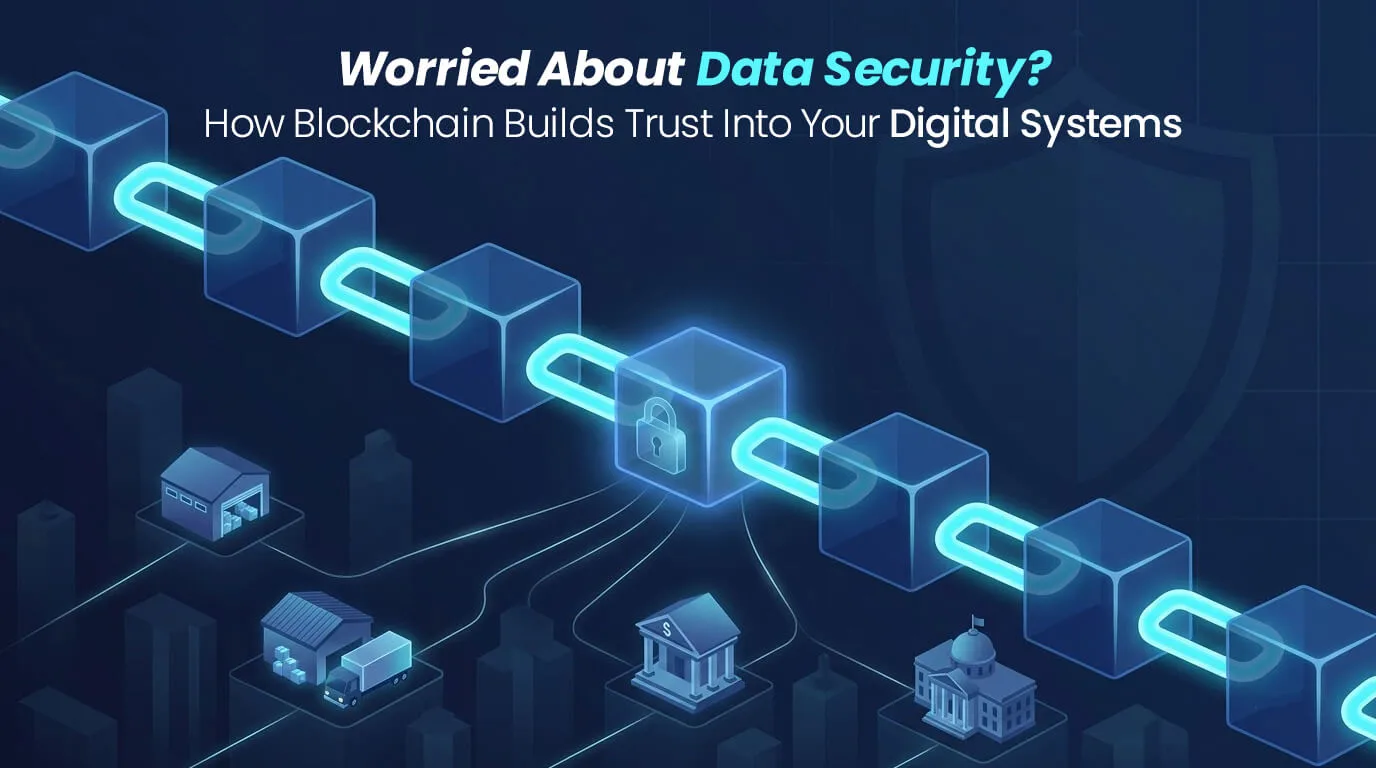
Blockchain flips the whole premise. Instead of trusting a person, you trust math and distribution. Every record links cryptographically to the one before it. Touch anything — even a single character — and the hash breaks. Visibly. Immediately. Across every copy of the ledger, not just the one someone might've had access to. Nobody has to trust the admin anymore. The system makes tampering obvious instead of quietly possible.
Forget the crypto-bro imagery. No ticker. No coin. No speculation, most of the time — enterprise blockchain work is duller than that, and better for it. What a real blockchain development company builds for a business looks more like this:
None of this has to be public-facing. Most enterprise blockchain work that actually ships is invisible to end users. It just quietly makes fraud, disputes, and "who changed this record" arguments a lot harder to have.

The trust cycle a blockchain implementation actually runs, end to end. Diagram: Swaran Soft enterprise blockchain framework.
Laid out side by side, it's easier to see exactly which problem each one is actually built to solve.
| Aspect | Traditional Database | Blockchain Ledger |
|---|---|---|
| Trust model | Relies on admin / department integrity | Relies on cryptography + distributed consensus |
| Audit trail | Lives inside the same system — editable | Immutable, tamper-evident across every node |
| Change detection | Manual review, often after the fact | Automatic — hash breaks instantly across copies |
| Best fit | Single trusted team, internal-only data | Multiple parties who don't fully trust each other |
| Typical use case | CRM, ticketing, single-tenant apps | Supply chain, BFSI reconciliation, land records |
| Real-world example | Internal quality-check database | State government land registry pilots (India) |
Source: manufacturing supply-chain audit patterns and publicly reported Indian state government blockchain land-registry pilots.
Let's be honest, because most vendors won't be. Blockchain isn't the right tool for everything. If your business runs on one internal database with three people who trust each other completely — you don't need a distributed ledger. That's not a knock. It's just true, and anyone telling you otherwise is selling something.
Where it actually earns its cost:
Multiple parties — supplier, manufacturer, logistics, buyer — none of whom fully trust each other's records. A shared, tamper-evident ledger means a quality certificate or a shipment timestamp can't get quietly "corrected" once a dispute starts.
Two institutions need to agree on a transaction history without either one controlling the source of truth. A shared ledger kills the endless back-and-forth of "our records say X, yours say Y" — the argument just doesn't happen anymore.
Once a record's entered — a property title, a certificate, a permit — it should be provably unchanged from that point forward. This is one of the clearest cases for blockchain anywhere. It's exactly why several Indian state governments have already piloted blockchain land registries.
Patient records moving between hospitals, insurers, and labs need to stay provably consistent at every handoff. Nobody wants to discover, three months later, that a lab result got "adjusted" somewhere in transit.
A single-tenant CRM. An internal ticketing tool. These usually don't need it — a regular database with proper access controls does the job fine. Bolting blockchain onto something like that isn't security. It's theatre with better branding.
Here's something most vendor pitches conveniently skip: a badly built blockchain system is barely better than the database it replaced. If your "blockchain" is really just one company's private server calling itself decentralised — you haven't fixed the trust problem. You've just renamed it and charged more for the rebrand.
A genuine blockchain development company should answer this plainly, without dodging:
This is engineering discipline wearing a newer technology's clothes — the same rigor that goes into any enterprise-grade system, just applied to a harder trust problem. Swaran Soft brings that same security-first posture across its work: ISO 27001 certified, DPDP and RBI-aligned data handling, the same VAPT and compliance discipline underpinning its cyber security practice.
A few blunt questions worth putting to any blockchain vendor, before there's a contract on the table:
If data integrity, tamper-proof audit trails, or multi-party trust is genuinely the problem sitting on your desk, it's worth a look at how Swaran Soft approaches blockchain and distributed ledger work — built with the same enterprise discipline behind its production AI and application deployments, not as a side experiment somebody's running on the weekend. You can see what that discipline actually looks like across Swaran Soft's case studies, where the common thread isn't the technology. It's whether the system held up under real use, months after launch day.
Trust isn't something you bolt onto a system afterward with stricter policies and a firmer memo about access controls. It has to be built into the architecture from day one, or it was never really there.
We review whether your trust problem actually needs a distributed ledger, or whether a properly secured database already does the job — at no cost.
Find out if your trust problem actually needs a blockchain, or something simpler.

AI Architect and Entrepreneur building India's Edge AI ecosystem. 25+ years in enterprise technology. Founder of Swaran Soft, Gignaati, and Copilots.in.