Chai. A wireframe on a napkin. "This should already exist, right?"
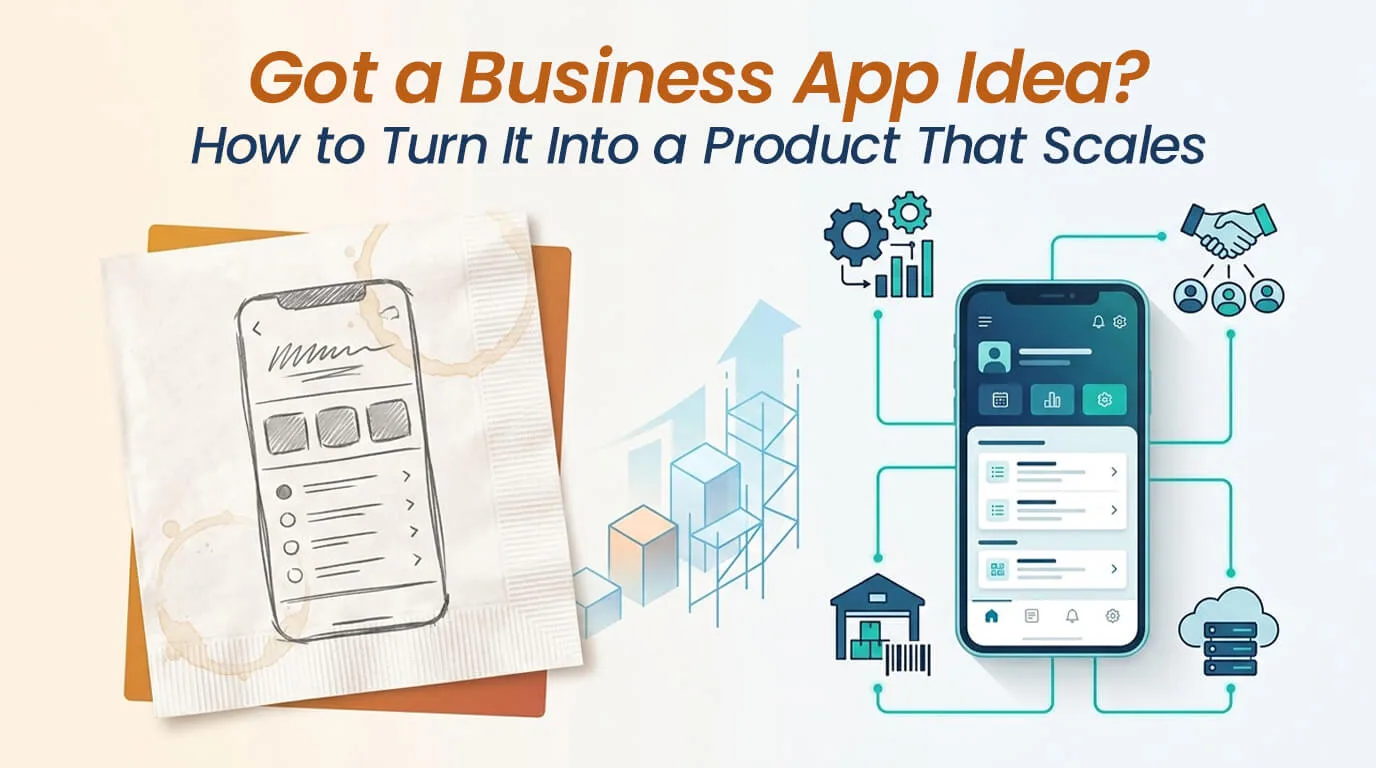
That's usually how it starts. And that's usually where founders get the first thing wrong — not the idea itself, which is fine, probably fine, ideas are cheap — but what they do in the six weeks after.
Here's the pattern. Somebody hires a freelancer off Upwork. Ships something in ten weeks. Works great for forty users. Falls over completely at four hundred. Nobody warned them, because nobody asked the boring questions upfront — the schema questions, the "what happens when this thing actually gets used" questions.
It's not a bad app. It's a prototype wearing a production badge it hasn't earned yet.
Your idea probably isn't that special. Harsh, but true — and worth hearing now instead of eighteen months from now. What actually separates "still running" from "quietly shut down" is execution. Decisions made in month one that nobody wanted to think hard about. A database schema someone rushed because "we'll fix it later."
You won't. Not without a rewrite. I've watched three different founders learn this the expensive way.
Which is why the mobile app development company you pick matters more than the one with the prettiest portfolio site. A freelancer builds you a screen. A real partner builds a system that can turn one screen into twenty without needing surgery each time.
Founders hear "scale" and picture servers. Load balancers. More RAM. Sure, fine, that's part of it. The quieter part is this:
A mobile app development company that's actually shipped enterprise products asks these questions before you do. If nobody on the other side of the table brings up API architecture, or offline-first design, or what happens at 10x traffic during a launch spike — that's not a small gap. That's the whole ballgame, and you just missed it.

How a business app idea actually becomes a scalable product — and where the freelancer route quietly detours into a rebuild. Diagram: Swaran Soft product engineering framework.
It helps to see the two side by side, because the differences are invisible right up until they aren't.
| Aspect | Typical MVP | Scalable Product |
|---|---|---|
| Goal | Prove the idea works | Prove it works under real load |
| Architecture | Quick, single-purpose | Modular, integration-ready |
| Typical timeline | 8–12 weeks | 3–6 months |
| Team | Freelancer or 2 in-house juniors | Established app development company |
| Integrations | None, or bolted on manually | ERP, CRM, inventory built in |
| Cost of change later | Low now, high later (rebuild risk) | Higher now, low later |
| Real example | Typical no-name freelance build | MonaWork — 12 weeks, ERP-integrated, 20K mobilisations/yr |
Source: Swaran Soft case studies — QC Inspection App (Honda India) and the MonaWork employee app (Monadelphous, Australia).
Every founder hits this fork. Build in-house. Hire freelancers. Or bring in an established app development partner. Nearly everyone picks wrong the first time, because the cheap-looking option looks cheap. On a spreadsheet. For about four months.
It rarely stays cheap. A freelancer who vanishes mid-sprint costs more in delay than you saved on their day rate. Two junior developers learning production architecture on your budget cost you in bugs that surface, without fail, right when you're demoing to a Series A investor. Neither is actually cheap. They're deferred expenses wearing a discount sticker.
What tends to work — especially for a first product — is a team that's already shipped things which survived contact with real users. Not a portfolio of pretty screens. A portfolio of apps still running, two years on, under actual load.
Take the QC Inspection App Swaran Soft built for a leading automobile manufacturer in India. Paper-based inspection, gone. Biometric login. GPS geo-fencing. 100% data accuracy, real-time dashboard. That's not a demo somebody clicked through once for a pitch. That's a system a factory floor leans on every single shift.
Or MonaWork — built for Monadelphous in Australia. Twenty thousand mobilisations a year. ERP-integrated. Delivered in twelve weeks. Still pulling five-star reviews on the App Store, which — if you've ever managed an enterprise app — you'll know is rarer than it sounds. Their own innovation manager said it changed how the whole workforce communicates. Not bad for something built in three months.
That's the bar. Not "did it launch." Did it hold up.
A scalable app assumes your first-version assumptions won't survive contact with reality — because they won't. Modular code. Clean API layers. A schema that doesn't assume one region, one currency, one everything.
If the app will eventually talk to inventory, payments, ERP, whatever — design for that now. Retrofitting integrations into a rigid codebase is where budgets quietly die.
The good ones don't disappear the day the app goes live. Monitoring. Iteration based on actual usage. Support that doesn't require re-explaining your whole product every time something breaks.
Most of this never makes it into a pitch deck. It shows up eighteen months later — in whether the thing is still standing, or whether you're quietly rebuilding it from scratch.
A few things worth checking before anyone signs anything.
Ask for case studies with real numbers, not logos. "We built an app for a Fortune 500 company" tells you nothing. "100% data accuracy, still in production, three years running" tells you everything.
Ask what happens when things go wrong — testing, security, the 2am bug. Anyone can build a demo that survives a five-minute walkthrough. Fewer can tell you, honestly, what happens when 5,000 people hit the app simultaneously during a launch.
And ask whether they build to your business or just to your brief. There's a real gap between a mobile app development company that executes your spec word-for-word, and one that pushes back when the spec has a hole you didn't see — because they've built enough of these to know exactly where the holes usually are.
If you're weighing this right now, it's worth a look at how Swaran Soft approaches app development — enterprise mobile and web builds, ERP-integrated, shipped in weeks rather than quarters. And if the idea has an AI layer somewhere in it — a copilot, an automated workflow, something smarter than a static form — agentic AI development is where that conversation starts, since the products holding up best right now were built AI-native, not retrofitted after the fact.
The apps that actually make it weren't better ideas. They were treated like the build mattered as much as the pitch did. Worth a browse through Swaran Soft's case studies if you want to see what "still standing" looks like once the launch-day excitement wears off.
We look at your idea or existing app and flag the architecture, integration, and scale gaps before they cost you a rebuild — at no cost.
Find out if your app idea (or existing build) is ready to scale.

AI Architect and Entrepreneur building India's Edge AI ecosystem. 25+ years in enterprise technology. Founder of Swaran Soft, Gignaati, and Copilots.in.