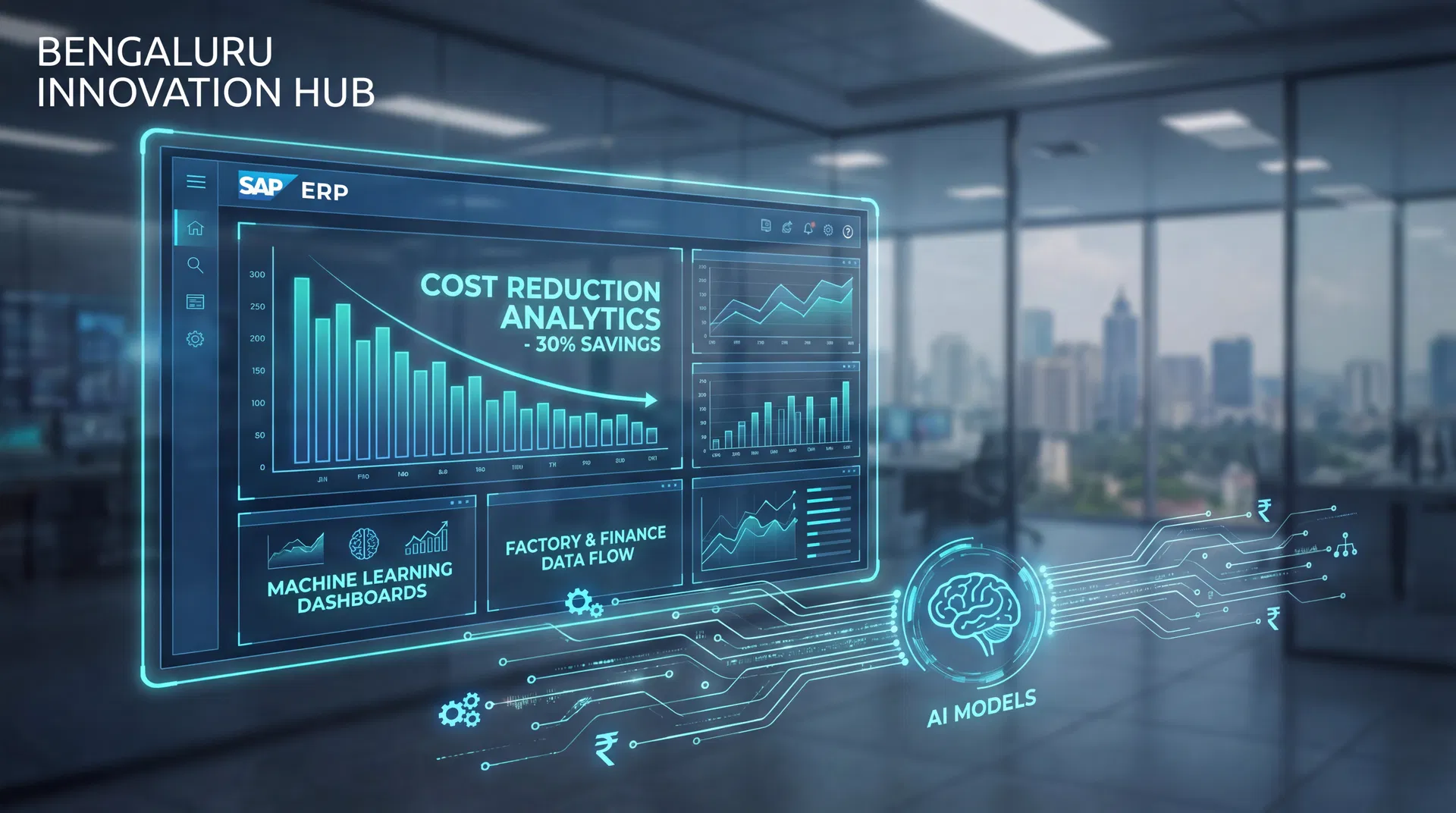
How Indian Enterprises Are Using ML Inside SAP to Cut Costs by 30%
Key Takeaway: Indian enterprises running SAP ERP are embedding machine learning models directly into procurement, production, finance, and quality workflows — achieving 18–40% cost reductions per module. This post explains the exact use cases, real case studies, and a 4-phase implementation roadmap.
The SAP Data Goldmine Most Enterprises Are Sitting On
The average Indian enterprise running SAP has accumulated 5–15 years of transactional data across procurement, production, finance, sales, and HR. This data — stored in hundreds of SAP tables — is one of the most valuable and underutilised assets in the organisation. Yet most companies use it only for backward-looking reports: what happened last quarter, last year.
Machine learning changes the equation entirely. Instead of asking "what happened?", ML models trained on SAP data answer: "what will happen next, and what should we do about it?" The result is a shift from reactive ERP to predictive ERP — and the cost savings are measurable, significant, and repeatable.
According to Gartner, enterprises that embed AI/ML into their ERP workflows by 2026 will outperform peers by 25% on operational efficiency metrics. For Indian enterprises — where margins are tighter and operational complexity is high — the opportunity is even more pronounced.
Where ML Delivers the Biggest ROI Inside SAP
Not all SAP modules offer equal ML opportunity. The highest-ROI use cases share three characteristics: large historical datasets, clear decision points, and quantifiable cost outcomes. Based on Swaran Soft's implementations across 12+ Indian enterprises, here are the modules and use cases delivering the most consistent returns:
| SAP Module | ML Use Case | Cost Saving |
|---|---|---|
| SAP MM (Procurement) | Demand Forecasting | 18–22% |
| SAP PP (Production) | Predictive Maintenance | 25–35% |
| SAP FI/CO (Finance) | Invoice Anomaly Detection | 12–18% |
| SAP SD (Sales) | Churn Prediction | 20–28% |
| SAP QM (Quality) | Defect Classification | 30–40% |
| SAP HR/HCM | Attrition Prediction | 15–20% |
Why Indian Enterprises Are Uniquely Positioned for SAP + ML
Several structural factors make Indian enterprises particularly well-suited for SAP ML adoption right now:
- Data volume advantage: Indian manufacturing and BFSI enterprises often have 10+ years of SAP data — far more than the 2–3 years needed to train reliable ML models.
- Cost pressure as a driver: With EBITDA margins under pressure from global competition and input cost volatility, even a 5% operational saving translates to significant bottom-line impact.
- SAP BTP availability: SAP Business Technology Platform (BTP) now offers native ML capabilities — including AutoML, anomaly detection, and time-series forecasting — accessible without leaving the SAP ecosystem.
- Databricks partnership: Databricks' India expansion means enterprises can now run ML workloads on data lakehouse architecture at Indian data centre latency, with full DPDP compliance.
- Government AI infrastructure: The IndiaAI Mission's AI Kosh platform provides free, curated datasets for fine-tuning industry-specific models — reducing ML development costs by 40–60%.
3 Real Case Studies from Indian Enterprises
Tier-1 Auto Components Manufacturer
Pune, Maharashtra₹4.2 Cr annual scrap cost from unplanned downtime in press shop
Deployed predictive maintenance ML model on SAP PP using vibration + temperature sensor data via Databricks
31% reduction in unplanned downtime; ₹1.3 Cr saved in Year 1
Mid-size NBFC
Mumbai, Maharashtra15% of vendor invoices had duplicate or inflated amounts — manual review took 3 FTEs
Isolation Forest anomaly detection model embedded in SAP FI AP workflow via BTP
94% anomaly detection accuracy; 2.5 FTEs redeployed to strategic work
Specialty Chemicals Enterprise
GujaratExcess inventory of ₹8 Cr due to poor demand forecasting in SAP MM
XGBoost demand forecasting model trained on 5 years of SAP purchase order history
Inventory reduced by 22%; working capital freed: ₹1.76 Cr
The Technical Architecture: How ML Connects to SAP
The most common architecture for SAP ML integration in Indian enterprises follows a three-layer pattern:
This architecture ensures that ML predictions are surfaced directly inside SAP screens — procurement officers see demand forecasts in SAP MM, quality managers see defect probability scores in SAP QM — without requiring users to switch tools or learn new interfaces. Adoption is dramatically higher when ML is embedded in existing workflows rather than presented as a separate "AI tool".
The 4-Phase Implementation Roadmap
Based on Swaran Soft's delivery methodology across 12+ SAP ML implementations, the following phased approach consistently delivers first measurable ROI within 90 days:
SAP Data Extraction & Profiling
- Extract historical data from SAP tables (EKKO, EKPO, MARA, VBAK, etc.)
- Profile data quality: completeness, consistency, outliers
- Define ML problem statement and success KPIs
- Set up Databricks workspace connected to SAP BTP
Model Development & Validation
- Feature engineering on SAP transactional data
- Train and evaluate candidate models (XGBoost, LSTM, Isolation Forest)
- Validate against holdout data; achieve target accuracy threshold
- Document model card: inputs, outputs, confidence intervals
SAP Integration & Deployment
- Deploy model as REST API on Databricks Model Serving
- Integrate with SAP via BTP API Management or RFC/BAPI
- Embed predictions into SAP UI5 screens or workflow triggers
- Configure monitoring: drift detection, retraining schedules
Adoption & Continuous Improvement
- Train SAP users on AI-assisted workflows
- Collect feedback loops to improve model accuracy
- Quarterly model retraining with fresh SAP data
- Expand to adjacent SAP modules based on ROI evidence
Common Pitfalls and How to Avoid Them
Starting with the wrong module
Fix: Always start with the module that has the highest data quality and the most clearly quantifiable cost outcome. SAP MM procurement is usually the safest first use case.
Treating SAP data as 'clean'
Fix: SAP transactional data is notoriously inconsistent — duplicate vendors, inconsistent UoMs, missing master data. Budget 30–40% of project time for data quality work.
Building models without SAP user input
Fix: The best ML features often come from domain experts who know which SAP fields actually drive outcomes. Involve SAP power users from Day 1.
Ignoring model drift
Fix: SAP data distributions change with business cycles, new products, and market shifts. Build automated retraining pipelines from the start, not as an afterthought.
Presenting ML outputs outside SAP
Fix: If users have to leave SAP to see ML predictions, adoption will be near zero. Embed predictions directly into Fiori apps or workflow notifications.
The Business Case: How to Get CFO Sign-Off
The most common barrier to SAP ML adoption in Indian enterprises is not technical — it is the internal business case. CFOs and CIOs want to see a clear ROI model before approving budgets. Here is a simplified framework that has worked for Swaran Soft's clients:
ROI Calculation Template (Manufacturing Example)
The key is to anchor the business case to a specific, measurable cost line that the CFO already tracks — not to abstract "AI benefits". Procurement savings, downtime costs, and working capital tied up in excess inventory are all CFO-visible numbers that make compelling ML business cases.
Is Your SAP Instance Ready for ML?
Before starting an SAP ML project, a brief readiness assessment covers four dimensions:
- 1Data Readiness: Do you have 2+ years of clean transactional data in the target module? Is master data (material, vendor, customer) reasonably consistent?
- 2Infrastructure Readiness: Do you have access to SAP BTP or an equivalent integration layer? Is there a data warehouse or lake where SAP data can be extracted?
- 3Talent Readiness: Do you have an internal data team, or will you need a partner? Is there a SAP functional expert who can collaborate with the ML team?
- 4Organisational Readiness: Is there executive sponsorship? Are the SAP users who will consume ML predictions involved in the project from the start?
If you score 3 or 4 out of 4, you are ready to start. If you score 1–2, a 4-week readiness sprint — focused on data quality and infrastructure setup — will prepare you for a successful ML project.
Next Steps: Starting Your SAP ML Journey
The enterprises achieving 30%+ cost reductions from SAP ML are not necessarily the largest or most technically sophisticated. They share one common trait: they started with a specific, well-scoped use case, measured results rigorously, and expanded from there.
Swaran Soft's SAP Intelligence & Machine Learning practice has delivered 12+ implementations across manufacturing, BFSI, chemicals, and healthcare — all using the Databricks medallion architecture on SAP BTP. Our typical engagement starts with a 2-week discovery sprint that produces a prioritised ML use case backlog, a data readiness assessment, and a business case model ready for CFO review.
Ready to Cut SAP Costs by 30%?
Get a free 2-week SAP ML readiness assessment. We'll identify your top 3 ML use cases and build the business case.
Related Service
SAP Intelligence & Machine Learning
Databricks-powered ML on SAP BTP for Indian enterprises
Learn moreBy the Numbers

AI Architect and Entrepreneur building India's Edge AI ecosystem. 25+ years in enterprise technology. Founder of Swaran Soft, Gignaati, and Copilots.in.