
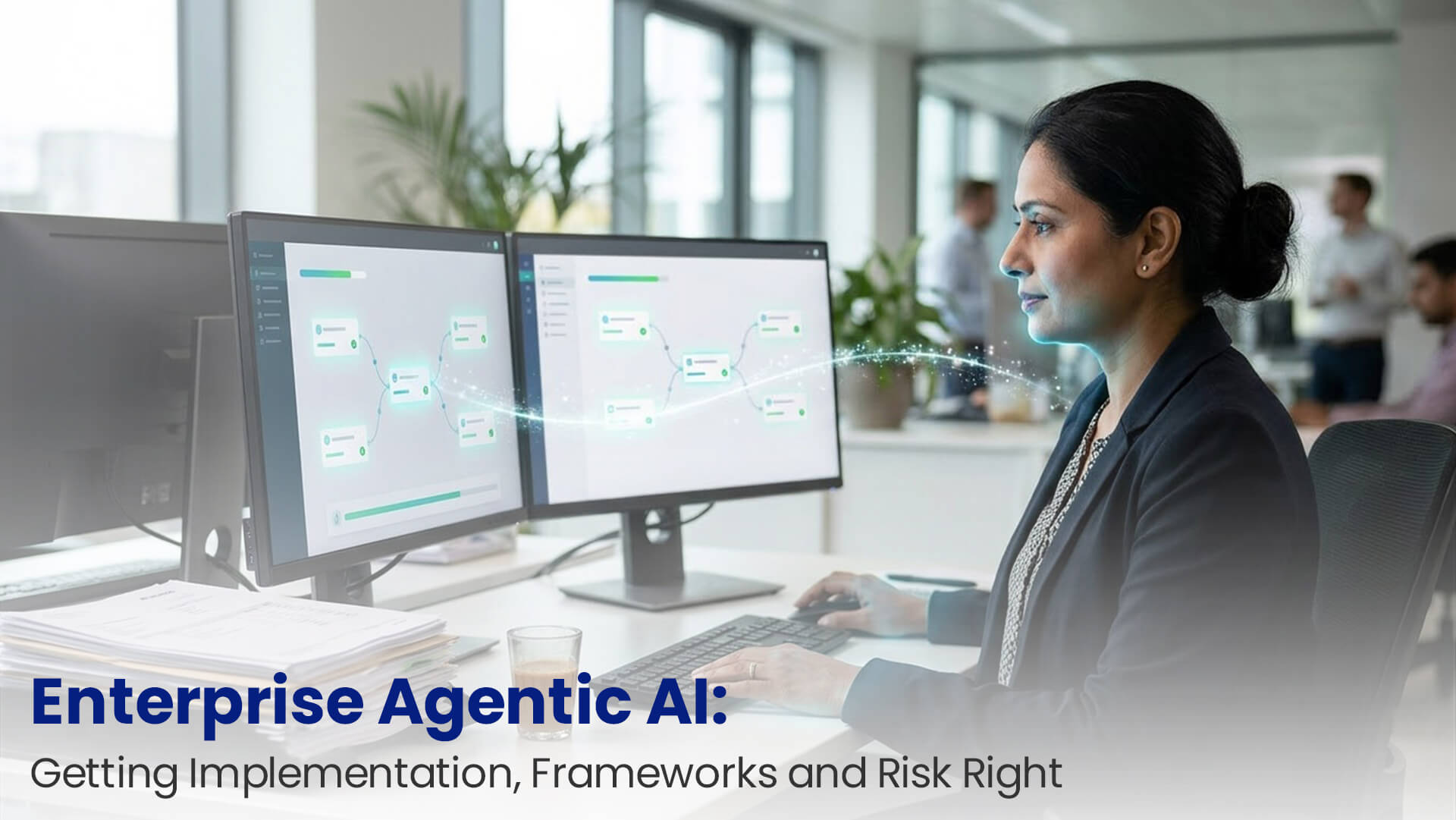
Picture your procurement desk. Meena runs it. Something like 400 purchase requests hit her team every month, and each one needs its budget checked, its vendor checked, two people to sign it off, and then someone (usually Meena, if she's honest) keying it into the ERP. She'll tell you over tea that it's the most boring part of the job. Mistakes slip in. And somehow the one request that's actually urgent is always sitting in the inbox of the person who just went on leave.
Work like that is what enterprise agentic AI is for. A chatbot will happily tell you the status of a request. An agent goes further. It figures out the steps, logs into your systems and gets the thing done, while your people still make the calls that matter. In this piece I'll explain what agentic AI actually is, the frameworks that keep it in one piece, how I'd roll it out, and how to deal with the risks of letting software act on your behalf.
If Meena asked me what it is, I'd say: you give the AI a job to finish, not a question to answer. Process this vendor invoice, for instance. It then works out on its own what needs doing first, goes off and gets the figures, checks them against your rules, makes the changes in your systems, and sends Meena a little note saying here's what I did.
People mix this up with chatbots all the time. A chatbot talks. An agent does stuff. That's where all the speed comes from, sure, but it's also the reason you can't just let one loose. It needs fences, it needs someone watching, and there has to be a big obvious button a human can press to take over.
In a big company you'll often find three or four agents sharing the work, almost like a little department. One's reading documents all day. Another's checking them against policy. A third is updating the ERP, and there's a coordinator keeping everybody honest. They manage regional languages too, which is a big deal if your field staff and customers are in Nashik and Madurai rather than Mumbai and Chennai.
So which job should go first? Look for one that's dull, has a rulebook, and turns up again and again, hundreds of times a month. Meena's purchase requests are perfect. So are employee helpdesk questions, matching invoices, telling customers where their order is, onboarding checklists and compliance reports.
Where they really come into their own is the kind of job that hops from one system to another and back. Watch someone in accounts finish one job and you'll often see them log into four separate screens to do it. An agent does the same thing through direct connections, in a fraction of the time, even at 3 in the morning. And because it goes through exactly the same steps every time, auditors tend to be rather fond of it.
Hold back where heavy legal, medical or financial judgement is involved. Agents can prepare those decisions, but a person should make them.
Nearly every agent I've seen working properly in production has three roles inside it. If you've ever helped organise a wedding, it's a bit like that. Somebody's in charge and knows what the day needs to look like, that's the orchestrator. Somebody else makes the list of what happens when, that's the planner. And then there are the people actually running around doing things, the executors, each with one job, maybe reading a PDF, maybe changing a record.
Why bother splitting it up? Because when something breaks, and something will, you can see exactly which step went wrong and why. Testing, auditing and fixing all get much easier. The alternative is staring at one big black box and guessing.
Some agents shouldn't be let off the leash at all, at least not yet. I tend to think in four levels. At the bottom the agent only suggests. Next it acts, but only after someone approves. Then it acts and tells you afterwards. And at the top it simply acts on its own. Most enterprises start at level one or two, and only move up once the results have earned it.
Whatever level you pick, put it in the agent's design document. That way everybody, the auditors included, knows exactly how much rope it has.
Every agent needs three things around it. First, a fixed set of tools, each with tight permissions. Second, some memory of what it's already done, otherwise it'll cheerfully do the same step twice. And third, guardrails, which stop it the moment it tries something outside its job.
One extra thing if the agent chats with customers. The guardrails need to cover manners and facts as well. Nobody wants a bot that snaps at a customer, gets the delivery date wrong, or sounds like it works for a different company.
My advice is to start with one agent doing one process, if you possibly can. Teams of agents are great for complicated workflows, but each extra agent is one more thing that can break, and one more thing to test and keep an eye on. I'd only go multi-agent once a single agent has got too tangled to manage.
Every step, every decision, every system it touches, and every exception, all of it on paper. Agents are brilliant at following rules, but only rules somebody has actually bothered to write down. Get a stopwatch out too (I'm only half joking) and note how long each step takes now, so a few months later you can show the before and after.
Sit down and agree, in writing, which things the agent may just get on with and which ones need a human nod. For the first few months at least, things like releasing payments, issuing refunds or making exceptions to policy should go past a human.
Treat the agent like a new joinee on probation. It gets the keys to the rooms it needs and no others. Give it its own service account, not Ramesh's login that half the office already uses, because you want every single action traceable to the agent. Swap its passwords and keys every so often, and on the day it's switched off for good, its access goes too.
Run it through real cases from last year first, and pick out the horrible ones on purpose, the half-filled forms and the invoices with three different dates on them. Then get a couple of your most mischievous colleagues to have a go at fooling it with odd inputs and hidden instructions. Anything that breaks, you fix before it ever touches live work.
For two to four weeks, the agent does the work in parallel but nothing it produces actually counts. You just line up its answers against what your team did. Happy with how often it gets it right? Then let it go live, approvals still switched on. Meena's lot should see those first results, by the way. They'll notice weird little things that would never show up in a test.
Make it log all of it. What it did, where it slipped, which cases it gave back. In the first few weeks somebody needs to sit and actually read those logs every week. Monthly is fine once it settles down. Remember the agent has no idea the business moved on. New approval rule, new vendor form, whatever it is, its rules and prompts have to be updated that same week.
Letting software actually do things on your behalf opens up some new ways for stuff to go wrong. The good news is that each one has a sensible fix, which is what this table is for.
| Risk | What it looks like | Control |
|---|---|---|
| Wrong actions | Agent updates the wrong record or approves an invalid request | Approval points, limits on values and actions |
| Data leakage | Sensitive data sent to an outside model or user | Private hosting, data masking, strict access |
| Prompt injection | Hidden instructions in a document or email trick the agent | Input filtering, tool restrictions, red-team testing |
| Runaway costs | Agent loops or makes excessive model calls | Usage caps, timeouts, cost alerts |
| No audit trail | Nobody can explain why the agent acted | Full action logs with reasons and timestamps |
| Regulatory breach | Personal data processed without proper basis | DPDP review, consent checks, retention rules |
Every agent should have a named owner, the same as any system or member of staff, so there's a real person to answer for it when things go sideways. And build a kill switch, a simple one, so anyone with the authority can pause a misbehaving agent in a few seconds.
The most dangerous one is giving an agent too much freedom too soon. Keep the job narrow to begin with, and only widen it once the results back you up.
Not keeping audit logs is nearly as bad. With no record of what the agent did and why, good luck explaining a decision to a regulator, an auditor, or a customer who's already furious.
Then there's building an agent on top of a process that's already a mess. All you get is a broken process that fails faster, so sort the process out first. And spare a thought for the humans sitting next to the agent. Meena's team need to know when they can just take its word, when it's worth a second look, and whose desk to walk over to when something seems off.
One more. If the only number you report is money saved, you're missing half the picture. Software acting in your company's name has to be accurate, has to stay within the rules, and people have to trust it, and those are worth measuring too.
On the numbers side, I'd watch three things closely. How many jobs it finishes. How often it's right when someone checks. And how often it throws its hands up and passes a case to a person. Then put today's time per task next to the old figure, and keep an eye on what it costs to run, model usage plus the hours people spend looking after it.
A good agent gets steadily better at the boring stuff. More jobs closed, fewer handed back, accuracy flat and steady (boring is good here). If you notice it passing more cases back to humans than it used to, don't wait for the quarterly review. Most times, someone tweaked a form or a process upstream and forgot the agent existed.
Once a quarter or so, take the team out for chai and ask them plainly if they trust the thing. Their answer is a good early signal of whether adoption will last.
Swaran Soft builds production agents using the orchestrator, planner and executor pattern on an open-source stack, so the system is yours and nobody locks you in. Our Managing Director, Yogesh Huja, wrote the book Adopting AI Agents, and its thinking on autonomy and governance runs through every project we take on.
Our HR AI agent shows what that looks like day to day. It cut query resolution from 2 days to under 4 minutes, with about 70% of queries handled automatically on WhatsApp. Our Cybersecurity & Compliance team checks each agent against DPDP and RBI requirements before launch, and our 8-week fixed-fee pilot takes the first one from contract to production.
Last word from me. I'm a fan of agentic AI, I'll admit it, because of how much grind it can lift off people like Meena. But it isn't forgiving. Cut corners and it'll show you. So go for work with a clear rulebook that repeats a lot, use a framework other people have already proven, keep the leash short in the early days, and be stingy with access.
Test it, then test it some more. Let it sit in the shadows next to your team until you're sure. Keep people in charge of the big decisions. Log everything, and put a person's name against every agent. Get those right and the agents turn into reliable digital colleagues. Get them wrong and you've just bought yourself a shiny new risk.
Want to talk it through with us? We run a free 45-minute AI Pilot Assessment. Drop a line to info@swaransoft.com, or ring +91 9220-313-650 (India) | +971-50-9292-650 (UAE). You'll find more at www.swaransoft.com

AI Architect and Entrepreneur building India's Edge AI ecosystem. 25+ years in enterprise technology. Founder of Swaran Soft, Gignaati, and Copilots.in.