
A manual report doesn't come with a price tag, which is exactly why it feels free. It isn't. Here's why businesses are moving to BI, what genuinely changes when they do, and how to make the shift without the upheaval you're likely bracing for.
Here's the thing about manual reports: nobody ever puts a number on what they cost to produce, so they slip through the books as free. Picture your actual month-end. Someone senior loses two or three full days pulling figures out of your accounting system, the CRM, and a handful of exports, dropping them into a single sheet, then chasing down why the totals won't agree, then formatting the whole thing so it's fit to show.
Then there are the costs you only notice once something breaks. One copy-paste slip, and a wrong number lands in front of the board. A decision gets taken on a report that was already a week stale. Or the master spreadsheet grows so tangled that exactly one person can follow it, and you feel a cold jolt the day they hand in their notice.
None of this means spreadsheets are bad. They're brilliant tools, and they got you here. The point is narrower: as a business grows, using them as the backbone of your reporting starts to cost more than it saves. That's the moment modern businesses look at BI.
Six concrete shifts, from the day the manual grind stops.
Hours Back on Report-Building — no more manual compiling. The days each cycle spent gathering, copying, reconciling and formatting simply disappear, because BI does that assembly automatically.
Fewer Errors in the Numbers — one version, verified. BI reads straight from one connected source and does the maths itself, so the figure on your screen is the figure in the system.
Always Current, Automatically — live, not last week. BI dashboards refresh on their own, so what you're looking at reflects now, not the state of things when someone last had time to rebuild the file.
Everyone Can Self-Serve — fewer bottlenecks. BI lets people answer their own questions from live dashboards, freeing the person who used to be the reporting department.
Deeper Questions, Answered — beyond the summary. BI lets you click straight into the detail and follow the question to its answer in the moment.
Scales as You Grow — no spreadsheet ceiling. BI is built to handle growth, so the reporting that just about works today doesn't become the thing holding you back tomorrow.

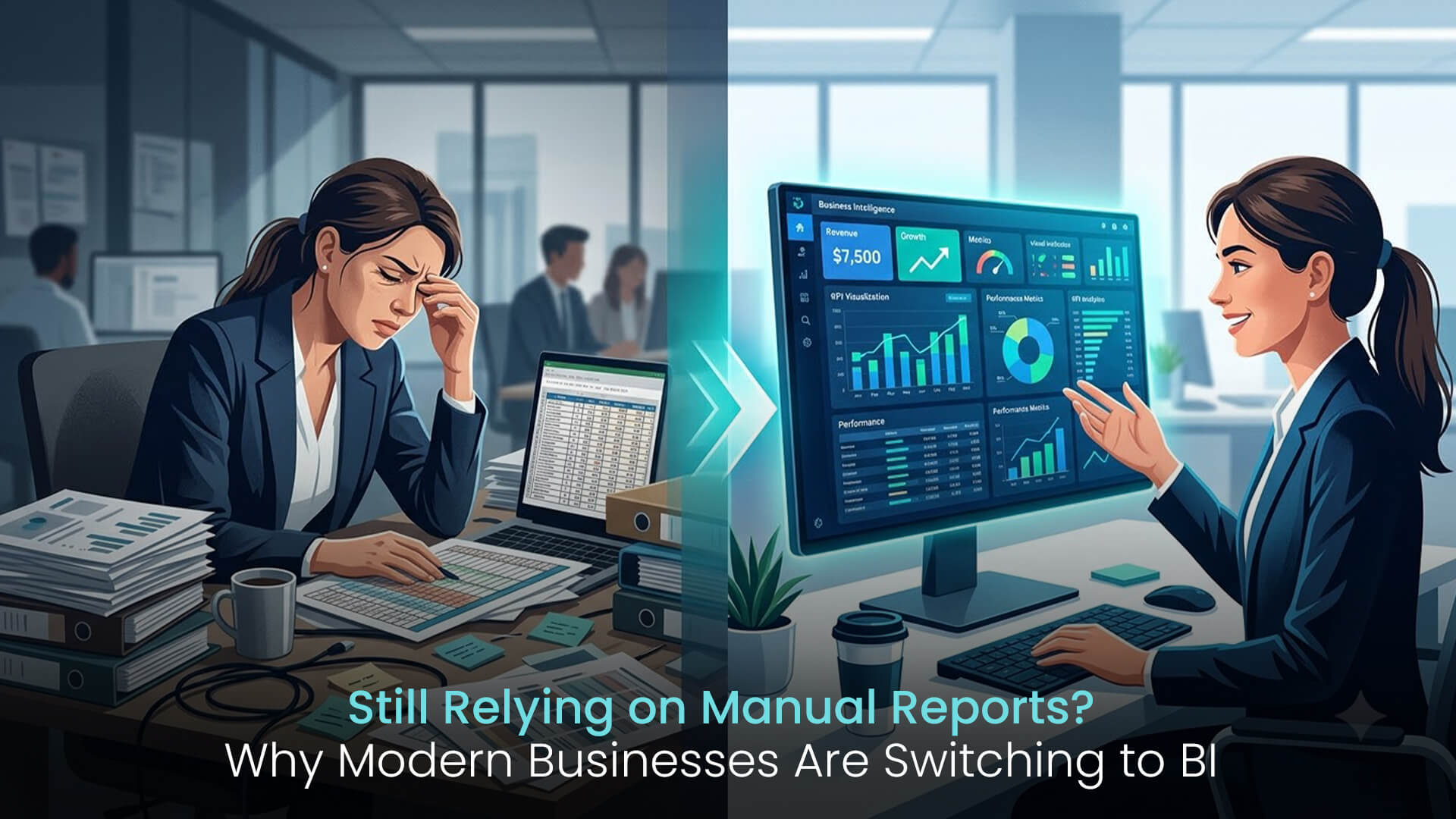
Illustrative view of the shift from manual, hand-built reports to live, automated BI dashboards.
Every line on the left is a familiar frustration of manual reporting. The right is what replaces it.
| The Manual Report Trap | After Switching to BI |
|---|---|
| Someone spends days each cycle building reports | Reports build themselves; that time goes back to the team |
| Copy-paste errors slip quietly into the numbers | Automated, consistent, verified figures from one source |
| The report is out of date by the time it's read | Always current, refreshed automatically |
| Only one person understands the master spreadsheet | Shared and documented, not fragile to one person leaving |
| Every new question means rebuilding a report | Ask new questions instantly, self-serve |
| Spreadsheets crawl or break as data grows | Built to scale past the spreadsheet ceiling |
| Data is scattered and reconciled by hand | One connected source, reconciled automatically |
| Insights stop at the totals | Drill into the why, not just the what |
The disruption people fear comes from doing it all at once. Three principles keep the move low-risk.
At Swaran Soft we don't move you off manual reporting in one leap. We start by connecting the data you already have and rebuilding your worst, most time-hungry reports first. That first phase is a matter of weeks, not months.
If you're moving off manual reports, there's a choice in how. Here's how the routes compare.
| Factor | Manual / Spreadsheets | Off-the-Shelf BI Tool | Managed BI (Built for You) | Usually Best |
|---|---|---|---|---|
| Setup effort | Low to start, high forever | Moderate, you connect it | Built and connected for you | Managed for a clean start |
| Data connected for you | No, you do it by hand | Partly, DIY connectors | Yes, done properly | Managed |
| Fits your specific needs | Yes, but fragile | Generic templates | Tailored to your business | Managed |
| Ongoing support | You own every fix | Vendor support only | Included, hands-on | Managed |
| Scales with growth | No, hits a ceiling | Yes, within limits | Yes | Managed or off-the-shelf |
| Cost model | Hidden, your team's time | Per-seat licensing | Project + support | Weigh against time saved |
| Best suited for | Very small, simple needs | Teams with data skills | Businesses wanting it done right | Match to your team |
Typical of a staged move from manual reporting to BI. Ranges, since it depends on how much reporting you do today.
Owns month-end reporting and lives the manual grind every cycle.
Pain: Days lost each month assembling and reconciling reports, with errors that surface at the worst times.
Outcome: Automated, verified reporting from one source, freeing the team from the month-end scramble to actually analyse.
Needs current numbers to run the business but gets stale, inconsistent reports.
Pain: Decisions wait on reports that are late and don't always agree, so the business runs a step behind.
Outcome: Live dashboards that are always current and consistent, so decisions happen on today's reality.
Weighing whether it's finally time to move off manual reporting.
Pain: A nagging sense that too much skilled time goes into building reports, and too little into using them.
Outcome: A staged, low-risk switch that pays back in time saved and sharper decisions, proven before scaling.
"Manual reporting doesn't fail loudly. It just quietly eats a few days of skilled time every cycle, carries the odd wrong number, and leaves you deciding on last week's data. Switching to BI is really about getting that time, and that certainty, back."
We identify your worst manual reports and scope a staged, low-risk move to BI — at no cost.
Find out which reports to rebuild first, and what a staged switch to BI looks like.

AI Architect and Entrepreneur building India's Edge AI ecosystem. 25+ years in enterprise technology. Founder of Swaran Soft, Gignaati, and Copilots.in.