Your IT partner has kept your systems running for years, so it feels natural to hand them the AI work too. Sometimes that works. Often it doesn't — and the reason has nothing to do with how good they are. AI is simply a different job. Here's what actually separates the two, and how to decide who should do what.
Let's start by being fair to the IT partner, because the point here isn't to run them down. If they've kept your ERP humming, your infrastructure stable, and your support tickets closing on time for years, that's real and valuable work. It's also hard work, and not everyone does it well.
But notice what all of that has in common. It's about reliability. Build the system to spec, integrate it, keep it running, fix it fast when something breaks. That's exactly what you want from the team that runs your business systems.
AI doesn't start with a known target. It starts with a question: where in this business would AI actually create value, and can our data even support it? You have to be willing to say "this use case isn't worth it" and kill it before it starts. You have to treat data as raw material to be tested, not just stored. And you have to plan for the fact that an AI model, unlike a piece of software, gets less accurate over time and needs tending.
When an enterprise assumes those two jobs are the same, the usual result is an "AI project" that's really a chatbot bolted onto a cloud API, with no data strategy underneath it and no plan for what happens six months in. It demos fine. Then it drifts, or it leaks data, or it never moved a business number in the first place — not because the IT partner is bad, but because they were asked to do a job outside their trade.
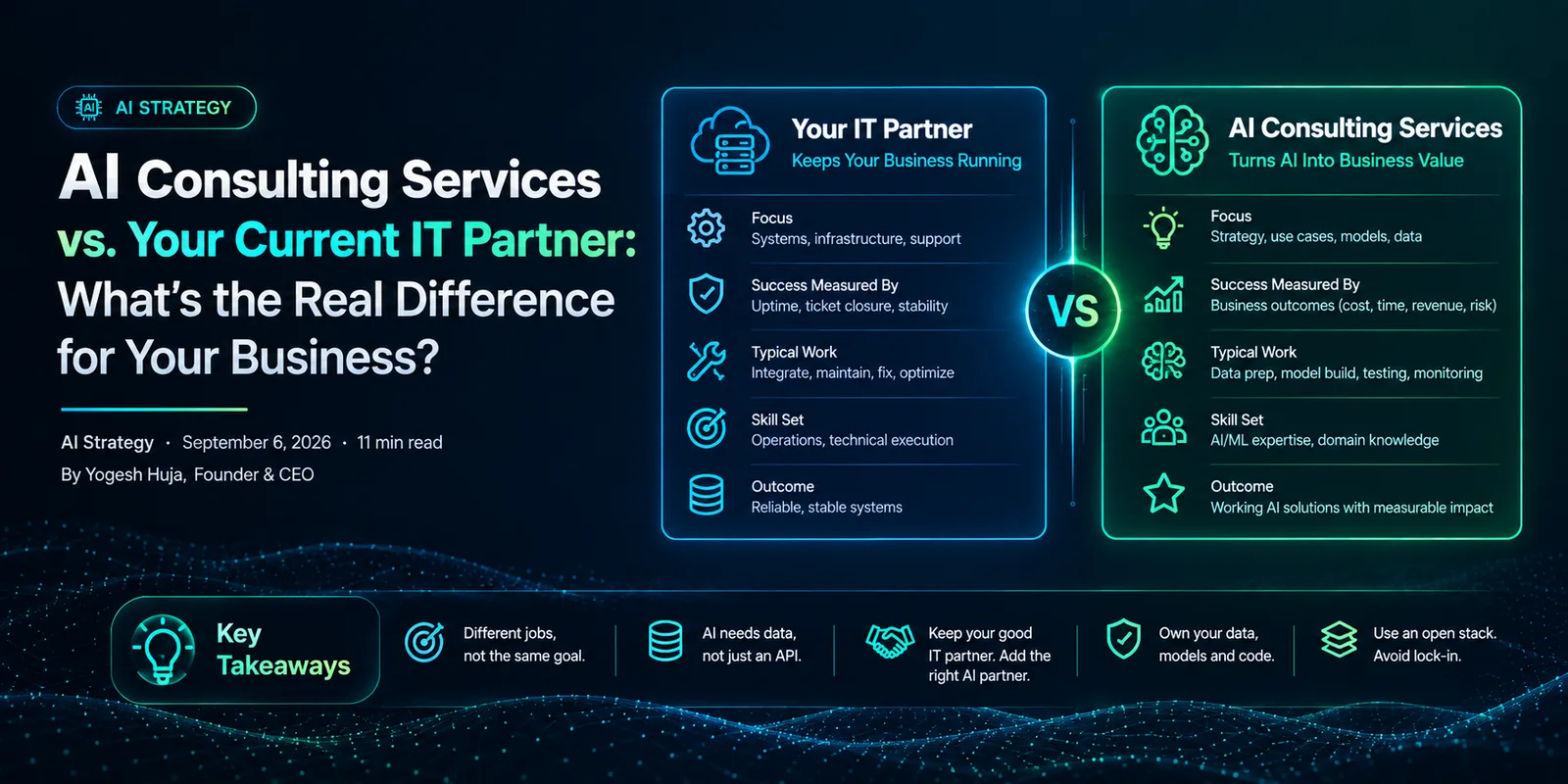
Same word, "consulting", two very different jobs underneath. This is the clearest way to see the split — and why AI consulting isn't just IT consulting with a new label.
| Traditional IT Consulting | AI Consulting Services |
|---|---|
| Starts with a defined brief to build | Starts by deciding what is worth building |
| Data is stored and secured | Data is audited, cleaned, and prepared as raw material |
| Uses whatever tool is specified | Chooses and tunes the model to fit the problem |
| Ships it and keeps it running | Ships it, then monitors and retrains as it drifts |
| Success = uptime and tickets | Success = a business outcome moved |
These six things sit at the centre of AI work and at the edge of traditional IT. That's the gap you're filling when you bring in an AI partner.
An IT brief usually arrives already decided: build this, integrate that. AI consulting works the other way round. It starts by asking which problems in your business would benefit from AI at all, ranks them by the value they'd create, and talks you out of the ones that aren't worth it. That filtering happens before anyone writes code, and it's where most of the money is saved.
To an IT team, data is something to store and protect. To an AI project, data is the raw material the whole thing is made of. An AI consultant audits where your data lives, how clean and consistent it is, and what's missing, then fixes those gaps before training anything. Skip this and the smartest model in the world produces confident nonsense.
A point tool ships with whatever model the vendor picked. A good AI consultant picks the right setup for what you're trying to solve — weighing how accurate you need it to be, and what privacy rules you have — then tunes the model using your own data. The key is the call you make here: it decides whether you get a good match, or something you merely learn to live with.
Here's a concept that doesn't exist in a traditional IT contract: models get less accurate over time as the world changes around them. An AI consultant builds in monitoring and retraining so the system stays accurate months after launch. Without a lifecycle plan, an AI project quietly degrades and nobody notices until it's embarrassing.
AI raises privacy and audit questions that ordinary software doesn't. Where does sensitive data flow? Can you explain a decision the model made? An AI consultant designs for the DPDP Act and sector rules from the first week, rather than treating compliance as a box to tick before launch.
An IT partner reports on availability and tickets, which is right for their job. An AI partner reports on the business number the project was meant to move: a shorter cycle time, a lower cost, a higher conversion. If your AI work is only being measured on 'is it up', you're measuring the wrong thing.
Each line on the left is a reasonable-sounding assumption. Each one, left unchecked, is where an AI project goes quietly wrong.
| The Assumption | What AI Actually Requires |
|---|---|
| Our IT team keeps our systems running well | AI needs someone who decides what to build and why, not only how to keep it running |
| They can wire an AI API into our app for us | A thin wrapper over a cloud API isn't AI strategy, and it quietly sends your data outside |
| We can fold AI into the maintenance contract | Maintenance is 'keep systems running'; AI is a build-and-tune effort with its own schedules |
| A model, once built, simply runs forever | Models drift as the world changes; they need monitoring and retraining on a schedule |
| Data is just something IT stores and secures | For AI, data quality and access are the whole game, not a storage or backup task |
| Compliance is a checkbox near go-live | AI privacy and audit needs are design decisions made in the very first week |
| One vendor for everything is simpler | Simpler until the AI part becomes a black box nobody can explain, change, or move |
If you want a fast way to tell real AI work from a rebadged IT project, follow the data. Real AI consulting keeps it close, treats its quality seriously, and keeps it in the country. A wrapper over a cloud API does the opposite.
The quality, consistency, and completeness of your data are audited and fixed before any model is trained.
On-premise or India-hosted deployment keeps sensitive data inside your environment — the clean route to DPDP Act compliance.
Open, model-agnostic components mean you own the models and code and can change or move them. No black box, no lock-in.
Swaran Soft works alongside your existing IT partner rather than against them. Through our AI strategy and consulting and Agentic AI development practices, we own the AI strategy, the data preparation, and the models — deployed on-premise through Copilots.in where sovereignty matters — while your IT team keeps doing what it does well.
This isn't about one option winning. It's about matching the right partner to the right job.
| Factor | AI Consulting Services | Traditional IT Partner | In-House IT | Point AI Tool |
|---|---|---|---|---|
| Primary strength | Deciding and building AI that pays off | Running and maintaining systems | Knows your environment deeply | One packaged capability |
| Picks the right use cases | Yes, ranked by business value | Usually takes the brief as given | If it has AI experience | N/A, it is the use case |
| Owns data & model strategy | Yes, audits and prepares data | Stores and secures data | Varies | Uses its own model only |
| Manages model drift over time | Yes, monitoring & retraining | Not typically in scope | If skills exist | Vendor's responsibility, hidden |
| Success measured by | Business outcomes | Uptime and tickets | Depends on mandate | Feature usage |
| On-prem / data sovereignty | Yes, India-hosted option | Depends on their setup | Data on vendor cloud | Your call to build |
A quick scorecard. The more of these are true, the more likely you're looking at genuine AI consulting services, not an IT project with a new label.
Pain: Unsure whether to stretch the existing partner into AI or bring in a specialist, and wary of creating a black box.
Outcome: A clean split of responsibilities: the IT partner keeps running systems, an AI partner owns strategy and models, and both work together.
Pain: Worried that a general IT vendor will treat data as storage and skip the quality work that AI actually needs.
Outcome: A partner who treats data as the product: auditing quality, fixing gaps, and keeping it in-country and compliant.
Pain: Hard to tell whether the 'AI' being proposed is real capability or a rebadged IT project with a chatbot on top.
Outcome: AI work measured by business outcomes, with a clear first use case and an honest read on what will and won't pay off.
"Your IT partner keeps the lights on, and that's worth a great deal. AI is a different job: deciding which rooms are worth lighting, and rewiring as the building changes. Ask one team to do both and usually one of the two suffers."
We review your current IT setup, identify where an AI partner adds value without disrupting what already works, and hand you a scoped first use case — at no cost.
Find out whether your AI plan needs a specialist partner, and where the line with your IT team should sit.

AI Architect and Entrepreneur building India's Edge AI ecosystem. 25+ years in enterprise technology. Founder of Swaran Soft, Gignaati, and Copilots.in.