You've heard "AI agent" a hundred times this year. Somewhere under the hype is a genuinely useful idea — and a lot of overselling. This guide skips the jargon and gets into what agentic AI services actually do in a business today, what they still can't do, and how to tell the two apart.
Two versions of the AI-agent story are doing the rounds, and both are wrong. One says agents will quietly run your whole company while everyone goes home early. The other says it's all marketing and nothing actually works. The truth sits in the unglamorous middle — which, frankly, is where most useful technology ends up living.
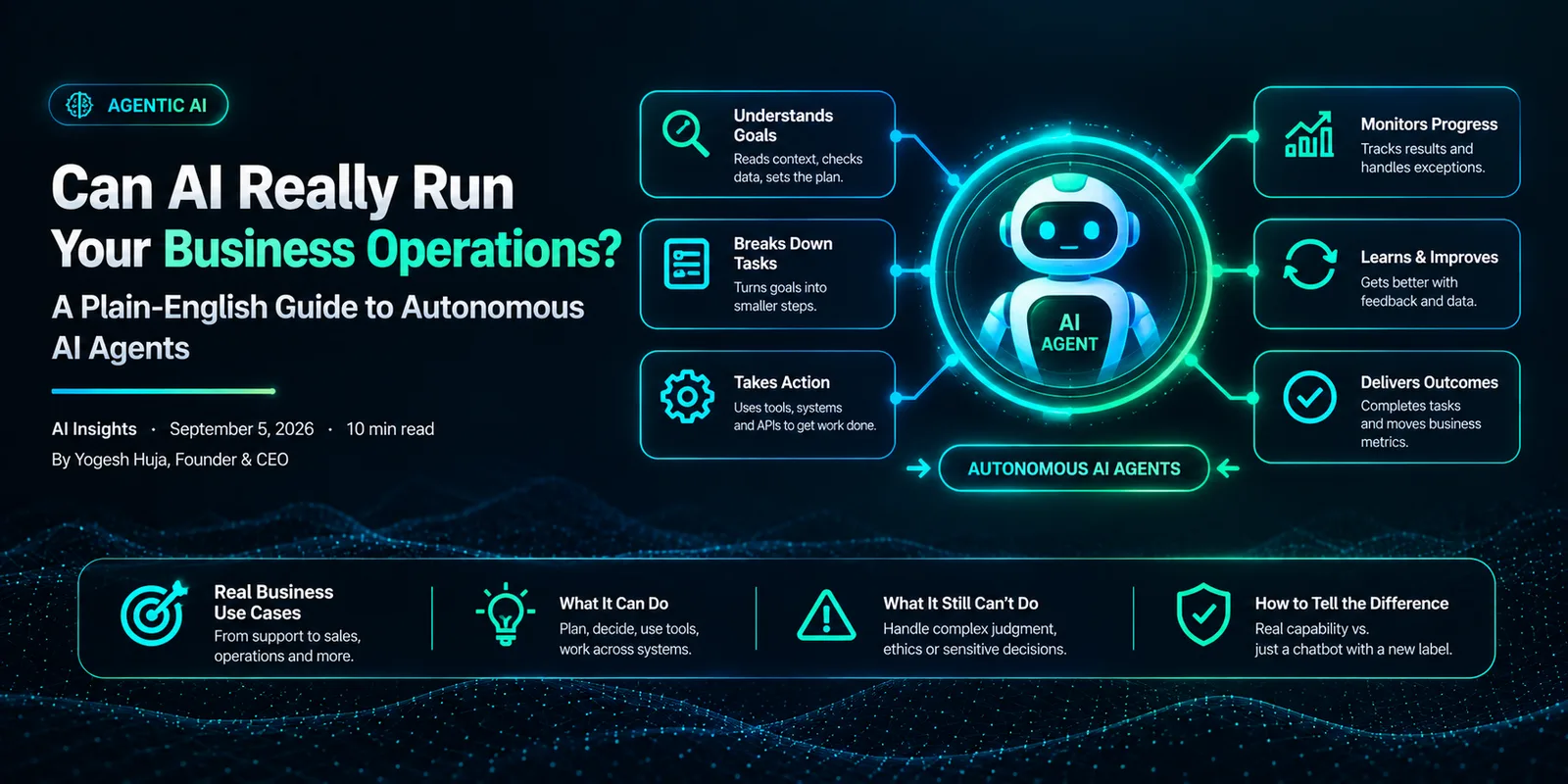
Think of it like this. Regular software runs through its set instructions in order. If you ask it to do something outside those rules, it just fails and stops. An AI agent is set up differently. You state a target in everyday words, then it figures out a path to reach that target. It uses the tools you gave it to carry out the work. It reads. It decides. It acts. And when it hits something it isn't sure about, it asks.
The core loop of agentic AI services: read the request, decide a path, act with your tools, and ask a human at the edge.
That last part matters more than any flashy demo. An agent that knows when to stop and pull in a human is worth far more than one that ploughs ahead confidently and gets it wrong. Real operational value comes from an agent doing the boring stuff reliably, and being honest the moment it hits the edge of what it knows.
So — can AI run your operations? It can run the repetitive, high-volume parts very well. The judgement calls, the exceptions, the decisions with real consequences — those stay with your people. They should. That split isn't a limitation you need to apologise for. It's exactly how you get the benefit without the risk.
A lot of folks swap these terms the same way, and that is where the mix-up begins. A chatbot is one kind of system; an agent is another.
| A Chatbot | An AI Agent |
|---|---|
| Answers a question | Completes a task |
| Lives inside one conversation | Connects to your tools and systems |
| Tells you how to do something | Goes and does it, within limits |
| Stops when the chat ends | Triggers the next step and follows through |
Forget the science fiction for a second. Here's the honest list of what well-built agentic AI services actually do well, in a real business, right now.
Same questions, same forms, same small tasks, hundreds of times a week. An agent takes those off your team's plate entirely: reads the request, does the work, confirms it's done. Your people stop being a human lookup table.
Emails, forms, tickets, WhatsApp messages. An agent reads them, works out what each one needs, and sends it to the right place — or handles it directly. The pile that used to sit waiting for triage gets sorted the moment it lands.
A good agent doesn't make things up. It's pointed at your policies, your documents, your product information, and answers from those. If the answer isn't there, it tells you and moves to the next step — it does not guess.
Most real work spans several tools: a CRM here, an ERP there, a spreadsheet stuck in between. An agent moves a task along the whole chain — updates the record, notifies the right person, kicks off the next process.
A good agent knows its limits and then passes the case to a person, with the right background. That choice is the reason autonomy can be safe at all.
Many people don't write in English, so support in Hindi, Tamil, Telugu, or Kannada is a real edge, not just a checkbox. Agents made for India can handle 9 or more Indian languages right away.
Most of the fear, and most of the hype, comes from the left column below. The right column is closer to how this actually plays out on the ground.
| The Myth | The Reality |
|---|---|
| AI agents will replace whole teams overnight | They take the repetitive slice; people shift to judgement, exceptions, and work that needs a human |
| You switch it on and it runs everything | You give it one clear job, connect its tools, prove it works, then widen the scope from there |
| An agent is basically a smarter chatbot | A chatbot replies; an agent acts. It completes the task instead of just describing it |
| It will invent answers and act on them | It's grounded to your data, with limits and human sign-off on anything risky or irreversible |
| Only giant tech firms can use this | A single, well-scoped agent pays for itself for a mid-sized business; you start small |
| It needs perfect, spotless data first | It needs good-enough data for one task; a short readiness check tells you what to tidy up |
| Once it's live you can never change it | It's configured, not carved in stone; you adjust its rules as the work itself changes |
| Our data has to go to a foreign cloud | It can run on-premise in India, so nothing sensitive ever leaves your own systems |
Two worries come up in nearly every conversation about agentic AI services: will it do something it shouldn't, and where does our data actually go? Both have straightforward answers, if the agent's built properly.
You decide what the agent can do alone, and what needs a human to approve first. Risky or irreversible actions always pause for a person — no exceptions.
Run it on-premise or on India-hosted infrastructure and no customer or employee data leaves your systems. The clean route to DPDP compliance.
Every action the agent takes gets recorded, so you always know what happened and why. Audit trails turn a black box into something you can defend.
Swaran Soft builds agents on an open stack that can run on-premise through Copilots.in, supporting 9+ Indian languages. You keep the data, you set the limits, and you turn autonomy up gradually as the agent earns trust. It's the foundation of our Agentic AI development and AI strategy and consulting work.
An AI agent isn't always the right tool. Sometimes plain automation is enough. Sometimes a human should just stay in charge. Here's roughly how the three line up.
| Aspect | Fully Manual | Rule-Based Automation | AI Agent | Human + Agent |
|---|---|---|---|---|
| Handles messy, varied requests | Yes, but slowly | No, breaks on anything unexpected | Yes, reads and interprets | Yes, with human backup |
| Understands context and language | Fully | Barely | Well, within its domain | Fully |
| Makes a real judgement call | Yes | No | Only within set limits | Yes, human decides |
| Scales with rising volume | No, needs more people | Somewhat | Yes, cost stays flat | Yes |
| Who's accountable for the outcome | The person | Whoever wrote the rules | The limits you set | The human in the loop |
| Best suited for | Rare, complex, high-stakes work | Simple, unchanging tasks | High-volume routine work | Routine plus judgement |
Rough figures, pulled from real deployments of a single, well-scoped agent. Your own numbers will move around depending on the process.
The pain: Volume keeps climbing and the only lever anyone offers is 'hire more people,' while backlogs pile up on the boring stuff.
What changes: The routine work runs itself, the team focuses on exceptions, and throughput goes up without adding headcount.
The pain: Agents burn out on repetitive tickets, response times slip at peak, and quality drops the moment someone switches to a regional language.
What changes: Common queries answered instantly, around the clock, in the customer's own language, while humans handle the genuinely hard cases.
The pain: Everyone's talking about AI agents, and it's genuinely hard to tell what's real today versus a sales pitch dressed up as a roadmap.
What changes: A clear, honest picture of where an agent actually fits, one scoped use case to prove it, and a plan that only expands once it's working.
"The question isn't whether AI can run your whole business. It can't, and it shouldn't. The question is which slice of the work is routine enough to hand over, so your people can spend their day on the part that actually needs them."
We identify the one process in your operations best suited for a first AI agent, and what it would take to get it live — at no cost.
Find out which process in your business is the best fit for a first AI agent.

AI Architect and Entrepreneur building India's Edge AI ecosystem. 25+ years in enterprise technology. Founder of Swaran Soft, Gignaati, and Copilots.in.