Voice AI bots are quietly replacing call-centre agents across India — cutting cost per call 60–80%, answering in 9 Indian languages, and lifting CX instead of breaking it. Here's how the smart enterprises are doing it without the robotic-IVR disaster everyone fears.
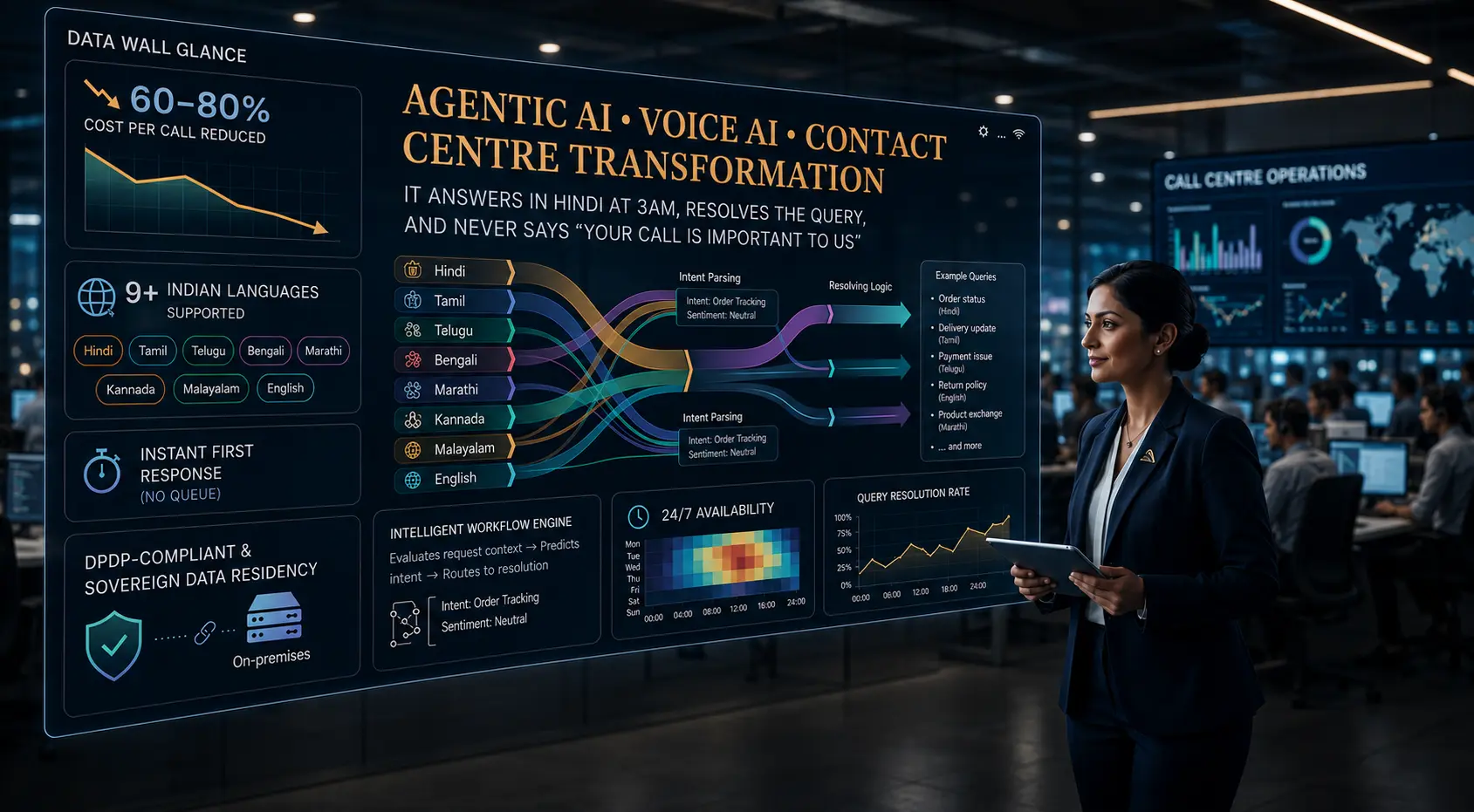
These numbers show up in every contact-centre audit. They never look good on a board slide.
The traditional contact centre was never really built for the customer — it was built for the org chart. Tiered support, shift rosters, average-handle-time targets, attrition running north of 40% a year in some BPOs. The whole model is a compromise between cost and coverage, and the customer absorbs the friction.
A few things broke that equilibrium at once. Indian-language speech models got genuinely good. Telephony providers like Exotel and Twilio made it trivial to plug AI into existing IVR flows. And the cost of running an LLM-backed voice agent dropped to a fraction of a fully loaded agent seat. Put those together and the math shifts hard.
Here's the part leadership tends to miss: the win isn't only cost. A voice bot answers on the first ring at 3am during festival season when call volumes spike 5× and no staffing plan can keep up. It handles 800 calls at once or 8, and the 801st caller waits exactly as long as the first — which is to say, no time at all.
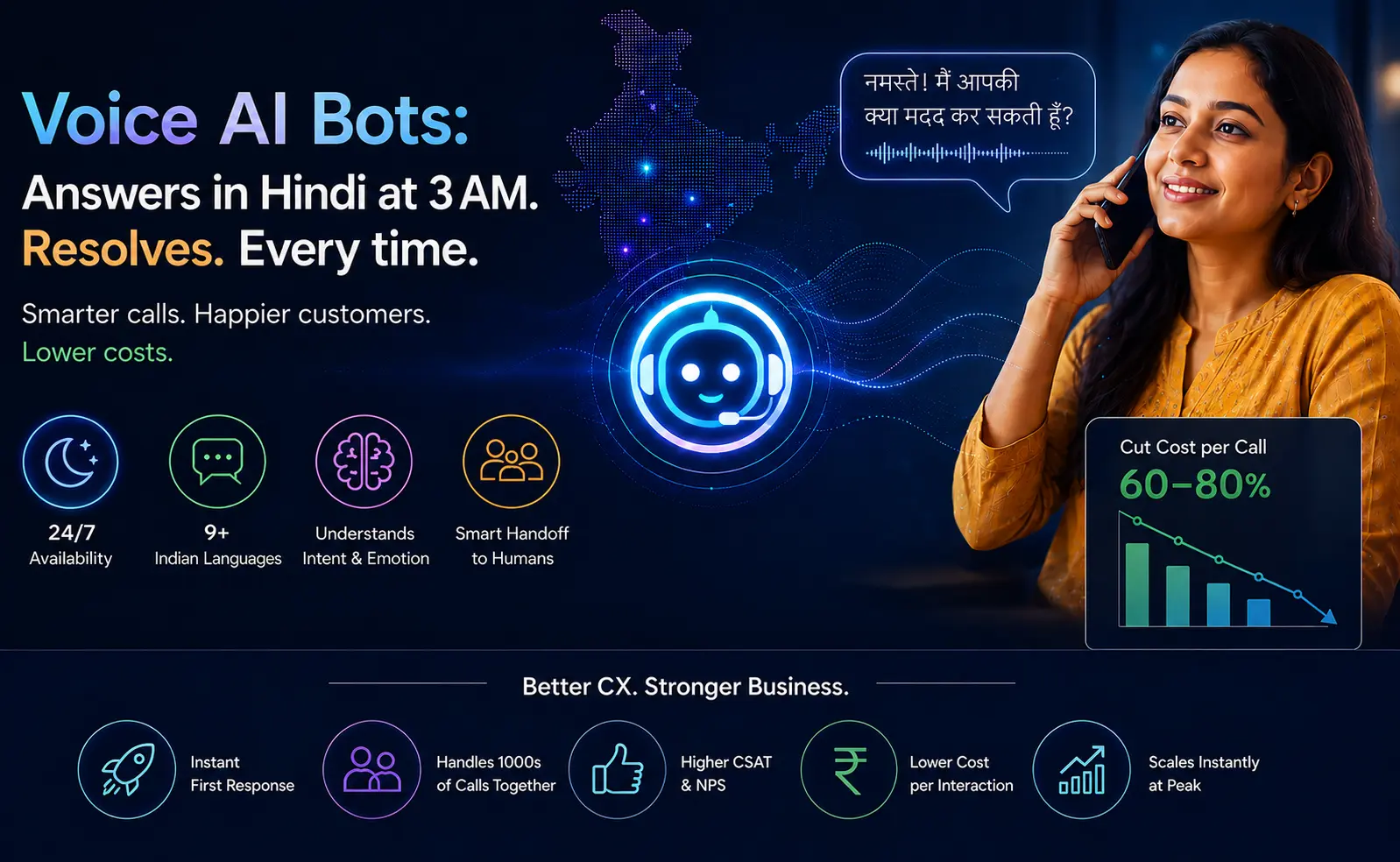
Most of us have screamed "AGENT. AGENT. REPRESENTATIVE" into a phone. Early voice automation earned its bad reputation — rigid menus, robotic TTS, dead ends. The current generation is different: it understands intent, holds context, detects frustration, and knows when to hand off. Done right, CX doesn't drop — it climbs. Done badly, the four choices below are where it goes wrong.
Modern stacks (Whisper to listen, ElevenLabs or PlayHT to speak) sound conversational — pauses and intonation, not the flat machine cadence customers learned to hate.
A customer in Coimbatore should speak Tamil and one in Indore Hindi — mid-sentence code-switching included.
The bot should sense rising frustration or a complex edge case and route to a human with full context, so the customer never repeats themselves.
It should already know who's calling and why — pulling from your CRM and order systems in real time.
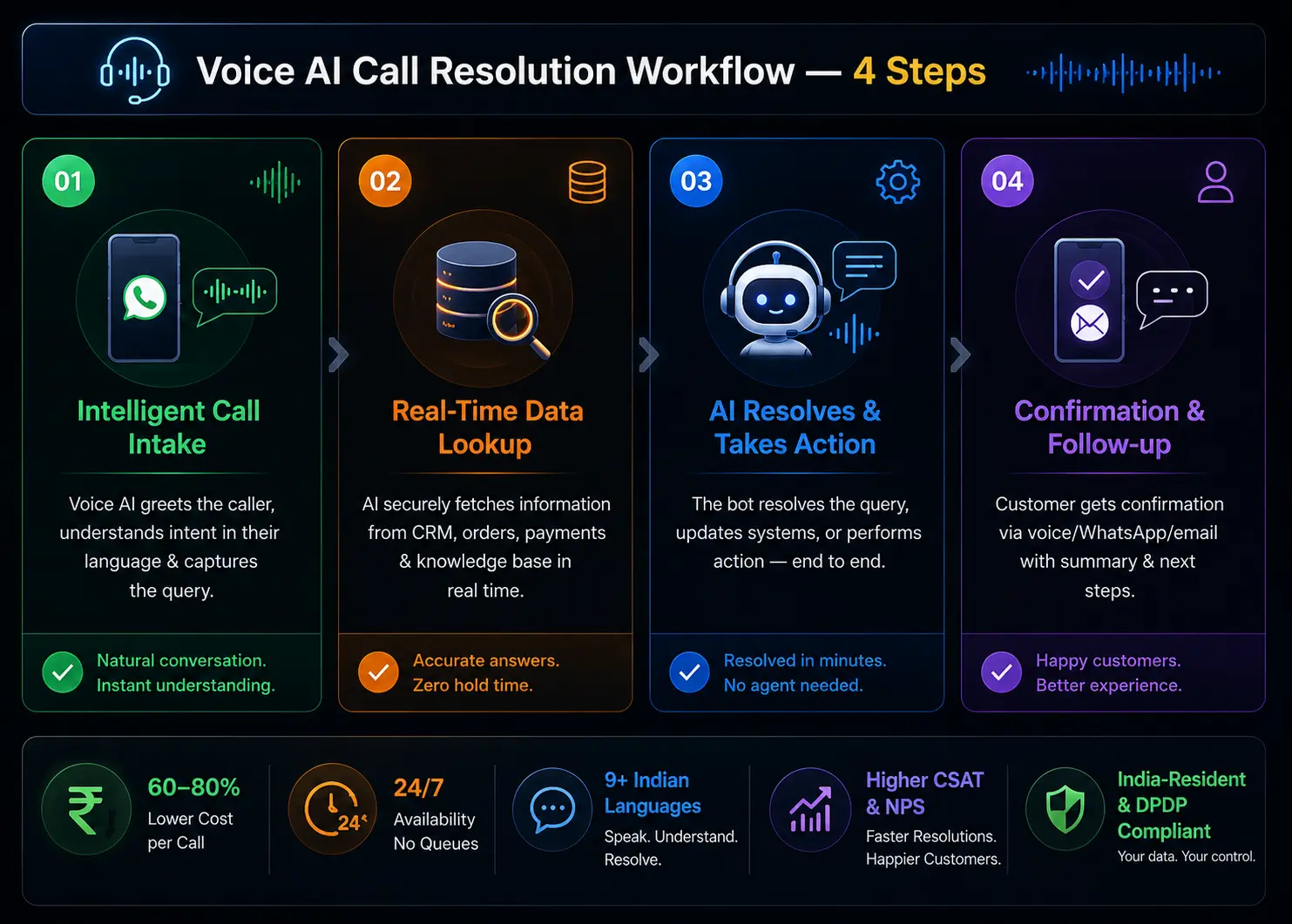
"Voice AI" stays abstract until you trace a single call through it. The flow looks like this — and notice that a human is still in the picture. Good deployments don't aim for zero people: they aim for the right people on the right calls.
CFOs don't approve voice AI because it's clever. They approve it because the business case holds up. Rough ranges from real Indian deployments — your mix will vary by sector:
The deeper return is harder to quantify: when routine queries vanish from the queue, human agents stop burning out, attrition eases, and the conversations they do have are the ones worth having. That compounds across a year in ways the cost-per-call line never captures.
Plenty of projects underwhelm, and it's rarely the model's fault. The failures cluster around four mistakes:
Script rigid trees and you get a rigid bot. The difference between a good deployment and a bad one is whether the bot understands intent or just matches keywords.
A bot with no graceful exit traps frustrated customers and tanks CSAT in a week. Escalation logic is not an afterthought — it's the most important part of the build.
Voice recordings are personal data under DPDP. If your vendor routes audio through servers outside India, that's a compliance problem waiting to surface.
In most of India, language isn't a feature — it's the whole experience. A Hindi-speaking customer handed an English bot doesn't feel served; they feel dismissed.
Swaran Soft builds voice AI agents on an open-source stack — Whisper, ElevenLabs, PlayHT, wired into Exotel, Twilio, Knowlarity and Ozonetel — with data staying inside India and the option to run fully on-premise. The practice covers inbound and outbound, real-time sentiment and escalation logic, and speaks 9 Indian languages out of the box. For commerce and support journeys that spill onto chat, it pairs naturally with WhatsApp AI.
What matters most to the leaders we talk to is the absence of theatre: a structured 3–4 week deployment, an open-source stack you actually own, and no vendor lock-in. If you're weighing the business case, the AI strategy team runs a short assessment that models the numbers against your own call data before anyone signs anything.
Book a free voice AI demo. In half an hour you get:
Yogesh Huja — Managing Director, Swaran Soft | Author, Adopting AI Agents
No cost. No commitment. Your data stays in India.
Model your cost-per-call savings, language coverage gap, and 12-month ROI — before you commit to anything.
Speak directly with Swaran Soft

AI Architect and Entrepreneur building India's Edge AI ecosystem. 25+ years in enterprise technology. Founder of Swaran Soft, Gignaati, and Copilots.in.