A practical guide for IPS officers and senior police decision-makers: how a sovereign, on-premise AI platform turns siloed CCTNS, CCTV and cybercrime data into one predictive intelligence layer — deployed in 8 weeks, not years.
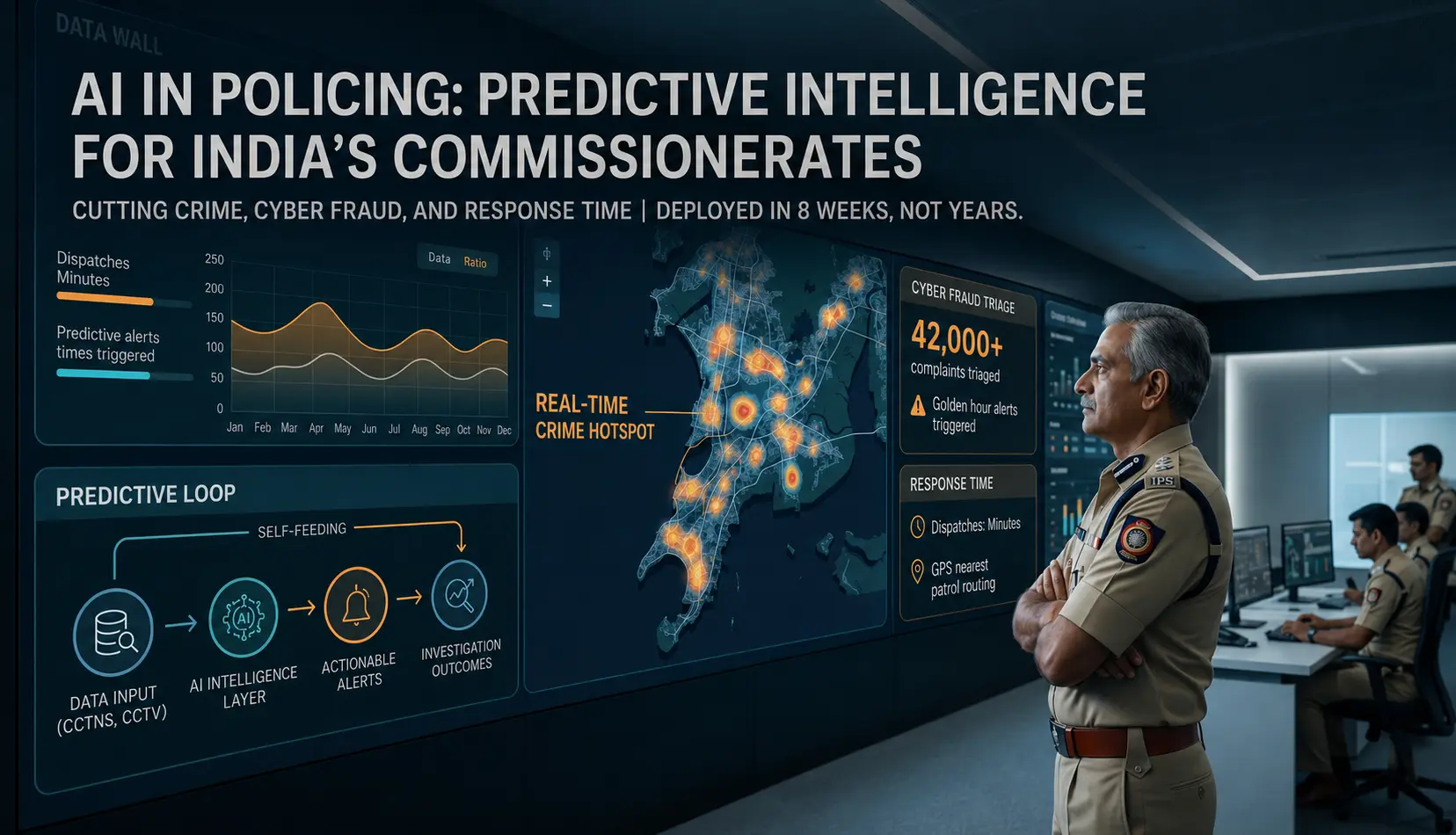
Picture a typical Indian corporate-capital Commissionerate: 35 lakh residents, 250-plus multinational headquarters, sixty thousand CCTV cameras feeding an ICCC. On paper, one of the best-resourced forces in the country.
Now look at the dashboard the Commissioner actually sees each morning. CCTNS in one window. ICCC video in another. The Cyber Cell's complaint queue somewhere else. Traffic on its own system. Five rich data sources, zero unified intelligence. The cameras capture everything and analyse nothing. That gap shows up in the numbers these cities are reporting right now:
None of these are failures of effort. They are failures of speed and visibility — the two things an AI intelligence layer is built to fix. The forces pulling ahead aren't the ones with the most cameras. They're the ones who finally taught their data to talk.
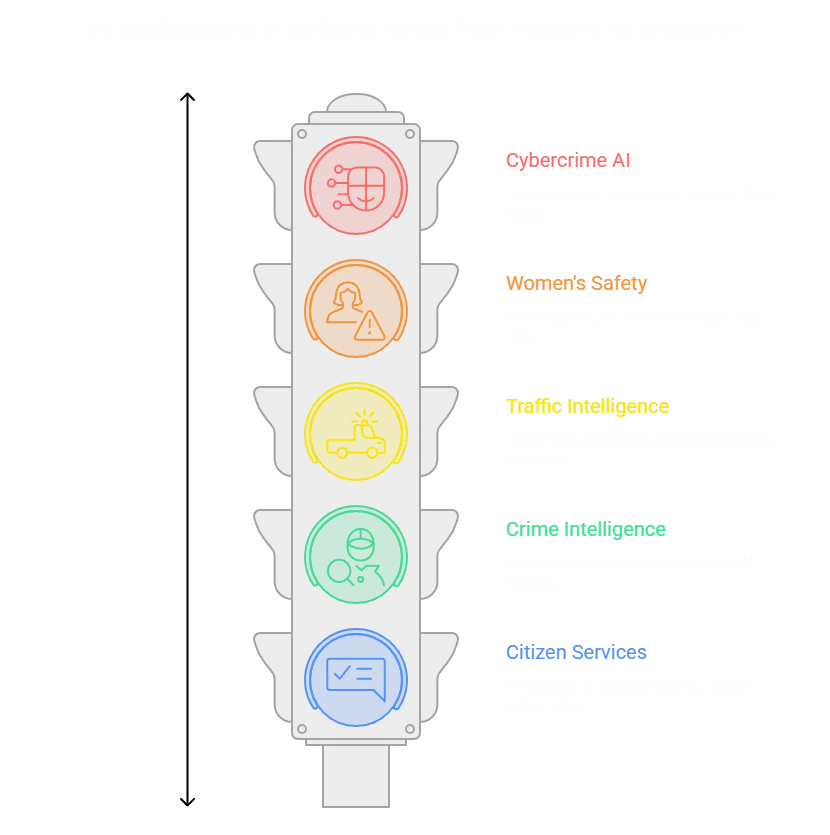
Strip away the jargon and an AI policing platform does five jobs a stretched force can never do manually at city scale. Each maps to a pressure every senior officer already feels.
The real change is structural. Old policing is a straight line — incident, report, investigate. An AI platform turns it into a self-reinforcing loop: city data sources feed an AI intelligence layer, which produces actionable alerts routed to the right officer in seconds, whose outcomes are logged back into the data so the next prediction is sharper.
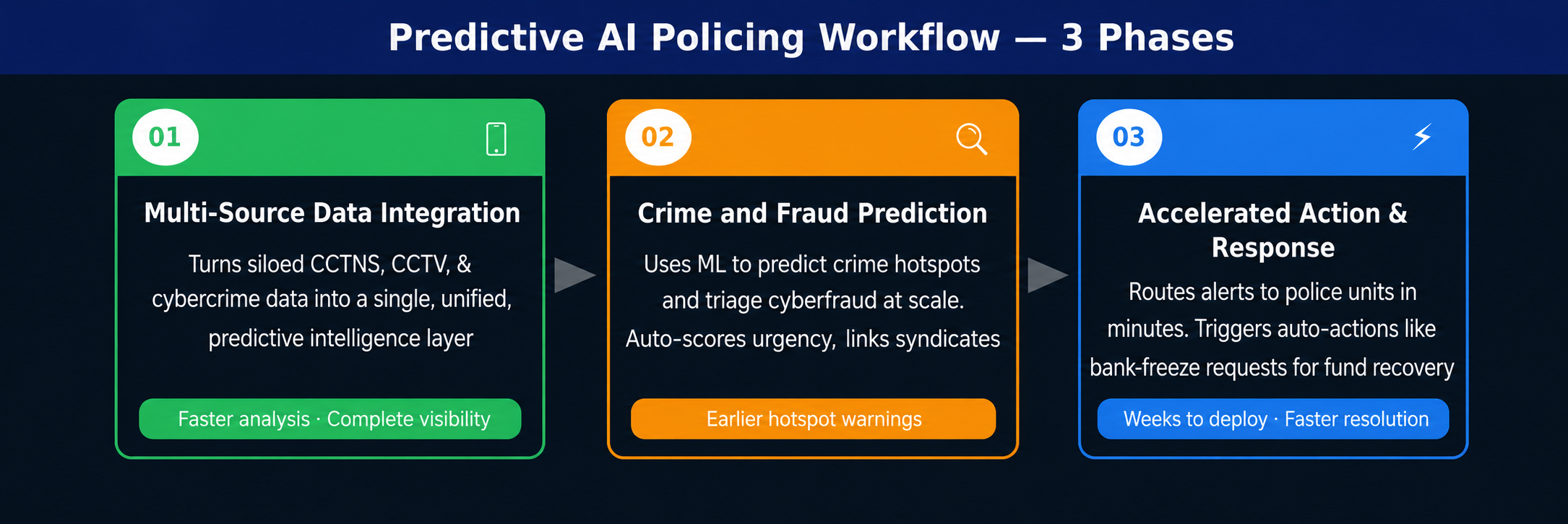
A one-directional, react-after-the-fact system can never close that loop. Pre-emptive deployment and faster investigation feed back into training data — so the next prediction is sharper than the last.
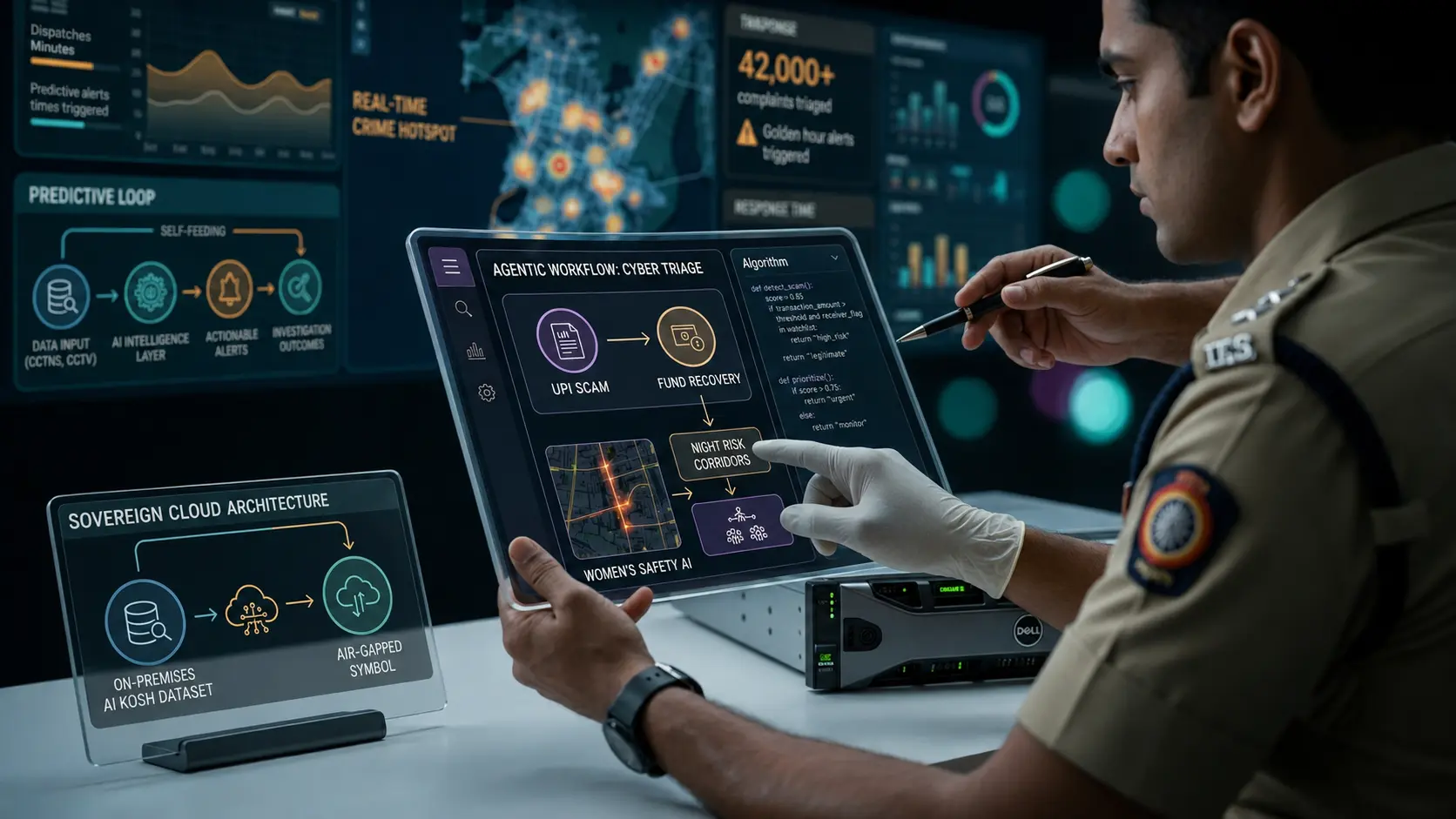
Here is the catch that separates a responsible deployment from a reckless one: where the data lives. FIRs, victim details, camera feeds — about as sensitive as data gets. Routing it through a foreign cloud is a non-starter under DPDP and most state AI mandates now explicitly require Indian sovereign compute with no offshore transfer.
Serious city-level deployments run 100% on-premise across a clean six-layer stack — the data never leaves the building, and the source code belongs to the department, not a vendor.
Open-source core: N8N · Ollama · Supabase · PostgreSQL. Indian sovereign models: Sarvam · Bhashini · Krutrim. Zero cloud dependency, zero vendor lock-in.
Swaran Soft has spent 25+ years delivering production enterprise systems — 1,500+ projects, 350+ clients, ISO 27001 certified, NASSCOM member, SOC 2 Type I underway. Three things matter for a police force, and they map directly onto how we work.
On-premise, air-gapped deployment on the department's own infrastructure. Full source code and documentation transferred. AI Kosh datasets. Zero cloud dependency.
9+ Indian languages — Hindi, Haryanvi, Punjabi, Tamil, Telugu and more. DPDP and IT Act aligned, full RBAC, court-admissible audit trail for every AI decision.
The same agentic-AI engineering that took enterprises from idea to live system in weeks, on best-in-class hardware (Dell, HP, Intel, AMD, NVIDIA).
We start with one module — we usually recommend Citizen Grievance AI plus the Crime Dashboard — prove the outcome on your data, and hand you a system your department owns. Not a multi-year tender that ends in slideware.
Identify highest-ROI module. Map against existing CCTNS and ICCC data. Fixed-fee contract signed.
On-premise deployment on department hardware. API integration with CCTNS, ICCC, cyber cell systems.
Production system handed over. Department team trained. Scale to remaining 4 modules on proven foundation.
Free 45-min AI Readiness Briefing for police leadership — a working AI demonstration, your highest-ROI module identified, and a sovereign on-premise deployment path, before you commit to anything.
Yogesh Huja — Managing Director, Swaran Soft | Author, Adopting AI Agents
State AI missions are funding this shift directly — hundreds of crores allocated, global AI centres anchored in the very cities under the most policing pressure, and explicit directives to integrate AI into public governance, including law enforcement. The mandate, the budget and the sovereignty requirement now point the same way. The cities that move first become the flagship demonstration projects; the rest spend the next cycle catching up.
Sovereign deployment guide, module ROI breakdown, and a 8-week pilot roadmap for police leadership.
Speak directly with Swaran Soft

AI Architect and Entrepreneur building India's Edge AI ecosystem. 25+ years in enterprise technology. Founder of Swaran Soft, Gignaati, and Copilots.in.